Praise is Fitting and Beautiful

Worship in the Word

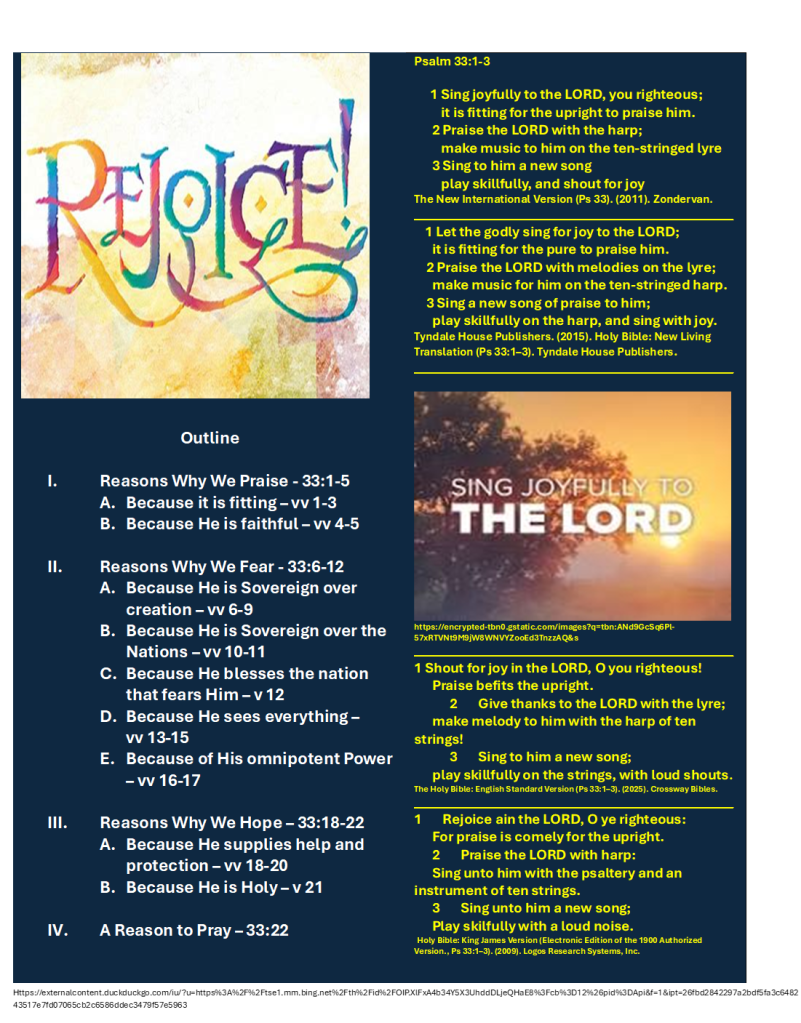
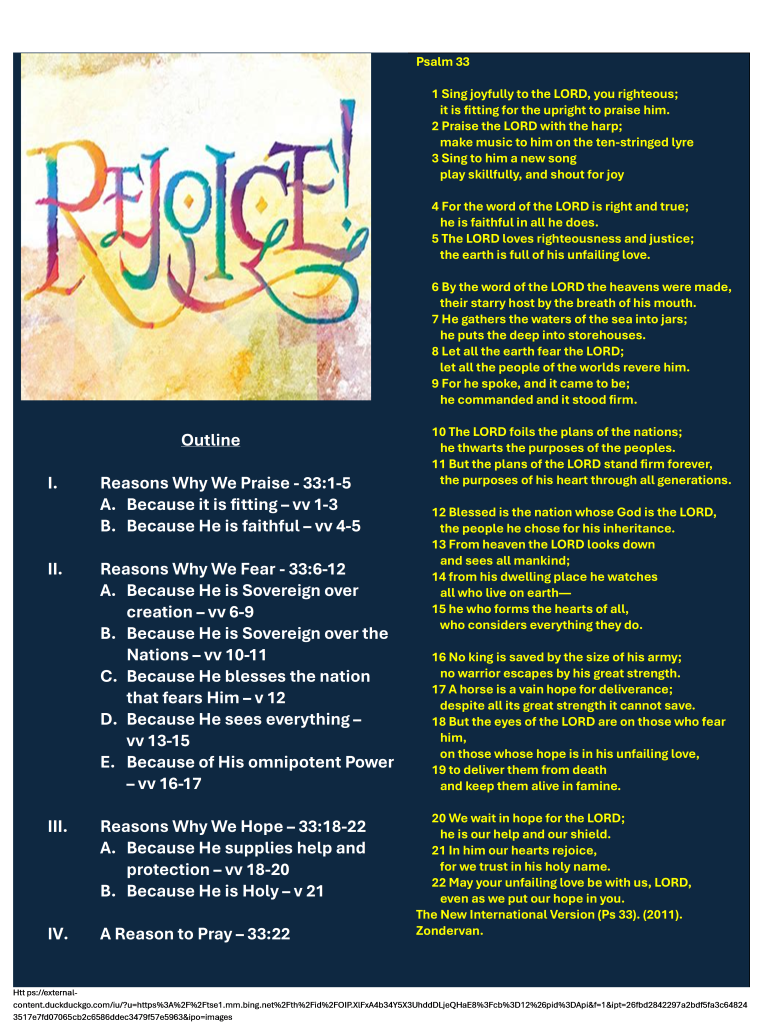
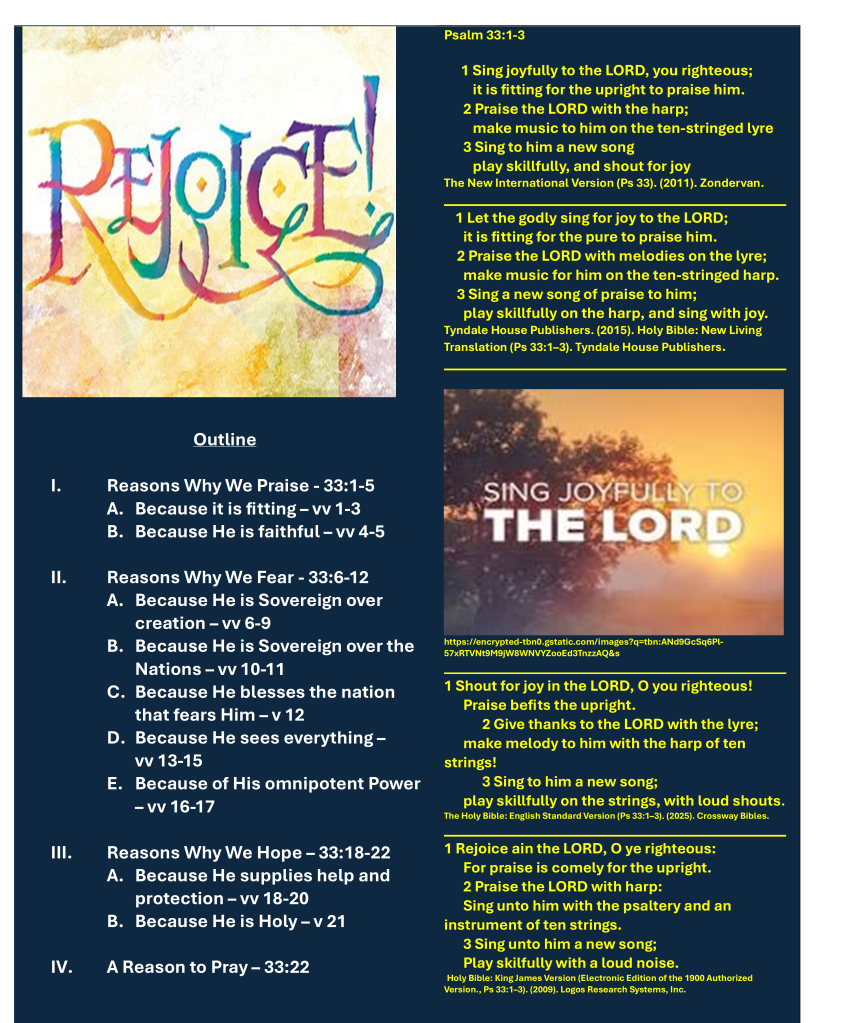
I. Reasons Why We Praise – 33:1-5

A. Because it is fitting – vv 1-3

B. Because He is faithful – vv 4-5

Not all the reasons, of course, but reasons stated in the first 5 verses of Psalm 33. I say stated, because there are many reasons implied throughout the Psalm. Even the subpoints under the headings aren’t exhaustive or consistent. For example, the subheadings under the first heading covering verses 1-5 need to be expanded on. And as you see, I used alliteration. In contrast, the subheadings under II-IV are not alliterative. But that’s enough clarification and self-criticism.

We could start by discussing whether the NIV’s translation of the Hebrew word rānah as “sing joyfully” is correct. Other versions translate it as “rejoice” (which conveys the emotion but not the method) or “shout” (which conveys the method, but not the emotion). But that discussion can come later.

I want to focus on the Hebrew word nāʾweh, which is translated as “fitting.” If you consult various translations, you will find that you can break them down into two basic adjectives: one that describes its appearance, and the other that describes its appropriateness or suitability. Versions like the CSB (Christian Standard Bible) translate nāʾweh as “beautiful,” which corresponds to the first description (appearance). While others, such as the NIV, render it as “fitting,” which corresponds to the second description (suitability). The KJV uses the word “comely,” a word not used much, if at all, today. It also refers to the attractiveness of a person or activity, though it can, secondarily, mean ‘proper’. The Amplified version incorporates both meanings in its translation of verse one: “praise is becoming and appropriate” – AMP (Amplified). Though the word “becoming” can refer to something that is either attractive or appropriate.

A look at Hebrew dictionaries and lexicons doesn’t shed much light on the matter, since the word is used elsewhere with one or the other meaning in mind. The only other passage in the Psalms faces the same translational variances (see Psalm 147:1 NIV, NASB) . Passages outside the Psalms don’t help either. Some contexts demand that it be translated as lovely or beautiful (E.g., Song of Songs 2:14). In contrast, others require the meaning of fitting or appropriate (e.g., Prov. 17:7). However, in the case of Psalm 33:1, both meanings are possible.

Instead of getting bogged down in the arguments for why it should be translated one way or the other, I am going to say that both meanings are “fitting” for God’s people (“the upright”). That to sing or shout out our praise is both beautiful and appropriate in our worship (“decently and in order,” of course-1 Cor. 14:40). I say “our” in a corporate sense, though private praise is fitting and beautiful too. But here, the psalmist is exhorting the “righteous” (plural in Hebrew) to worship the Lord.

Sing joyfully to the Lord, you righteous – Ps 33:2 NIV (2011)

Many today who claim to be Christians say, “I don’t have to go to church; I can worship at home or out in nature.” Worshipping at home and out in God’s wonderful creation is undoubtedly good, helpful, and edifying. However, Scripture also exhorts us to meet together in shared fellowship.

Worship in Witness

I recently read an article that said Gen Z  and millennials were returning to church. Yet, when you dig into the article, you discover that the average attendance has risen to 1.8 or 1.9 times per month, meaning less than half of the month. And this was contrasted with COVID-19 attendance, during which many churches were shut down. When I was attending Bible College back in the 1970’s, there was the running joke about people attending “Bedside Baptist” or “Parkway Presbyterian.” Many disregard the exhortation in Hebrews not to forsake “the assembling of ourselves together” (Heb 10:25 KJV).

The ESV translates this verse this way:

not neglecting to meet together, as is the habit of some, but encouraging one another, and all the more as you see the Day drawing near. The Holy Bible: English Standard Version (Heb 10:25). (2025). Crossway Bibles.

Verse 25 serves as the instrumental means to fulfill the exhortation found in verse 24:

And let us consider how to stir up one another to love and good works,

Verse 25 tells us how to accomplish the exhortation given in verse 24. How are we to “stir up one another to love and good works?” The comma at the end of verse 24 in the ESV points to verse 25, which tells us that we do this through our meeting together and “encouraging one another.” But note that there were some whose “habit” was to ignore or avoid joining in their local fellowship of believers, as it is today, sadly.

What is more “befitting” or “beautiful” than when the blood-bought body of Christ comes together and worships the Lord through the preaching of God’s word? Where we sit, as it were, at the feet of Jesus, having chosen the “good part,” “right thing,” or the “best part” (see Luke 10:42).

What is more appropriate or attractive when God’s family joins together in praise?

Praise the Lord! For it is good to sing praises to our God; for it is pleasant, and a song of praise is fitting. Psalm 147:1 ESV

Praising God takes our eyes off our problems and onto the Lord, in whose hands we are held (see John 10:27-30). Who works all things out for His glory and our good (see Rom 8:26-31). Who is both our Sovereign Lord (see Isaiah 46:9-10 and sympathizing Savior (see Hebrews 4:14-16 ESV, NLT).*

For we do not have a high priest who is unable to sympathize with our weaknesses, but one who in every respect has been tempted as we are, yet without sin.

Hebrews 4:14-16 ESV*

And it not only exalts God, but it is a means of grace by which God edifies us. Colossians 3:16 sums up the beauty, benefit, and befittingness of the ministry of preaching and of praise.

Let the word of Christ dwell in you richly, teaching and admonishing one another in all wisdom, singing psalms and hymns and spiritual songs, with thankfulness in your hearts to God.

ESV (see also 1 Cor. 14:26)

Hebrews 10:24-25 shows us the goal of fellowship: to “grow in love and good works.” We do this in light of “the day” (see Mt 24:44). That is, in light of the imminent return of the Lord in “an hour” we “do not expect”, which encourages us to be found worshipping and working for the Lord when He comes. It also reminds us that there is strength in numbers. An ember separated from the fire will soon go out. Habitually avoiding Christian fellowship can lead to depression and loneliness. It also reveals what we value most.

For where your treasure is, there your heart will be also. – Matt 6:21 NIV

But meeting together with other believers can have the same results as not attending. If we are not open to giving and receiving encouragement, or if our services are not conducive to achieving this, the results will be the same. Furthermore, if we only go to revel in the pleasure of enjoying the music, song, and preaching for ourselves, we may go home “blessed.” But we will not bless anyone else. How many times have you heard someone say, “I like going to church because it just makes me feel good?” I call them (and myself sometimes?) Dead Sea Attendees. Like the Dead Sea, where the water flows in but has no outlet. And they cannot sink because of the water’s saltiness. They take it all in and float all the way home. However, they never allow it flow out to help a brother or sister who is drowning in their sorrows, sins, and struggles.

Returning to Psalm 33:1, we can now see that the participle “fitting” serves to describe the need and necessity of praise in the life of the believer, both personally and corporately in the body of Christ. I believe this one word prompts the Bible explorer to look further along the path to find out why it is “fitting” and “beautiful.” A path that leads through the rest of Psalm 33 (and throughout all of Scripture) to find the treasure buried in this one single Hebrew word: “nāʾweh.”

*Some translations, like the ESV, render the Greek word πειράζω (peirazō) as ‘tempt’ or ‘tempted’.     Other versions, like the NLT, have ‘test’ or ‘tested’. Both are possible, and perhaps the author of Hebrews meant both meanings, for surely both are true. Truly, our Lord is a sympathizing Savior in both the testing and the tempting we face. Hallelujah

Worshipin Promise, Poem, and Praise

Burning Coals

O Christian, you are burning coal

Aflame with a loving fire

With an all-consuming goal

To encourage and inspire

But like a coal that falls away

This truth you must remember

When you choose to go astray

You become a dying ember

Not Just a Duty

Our praise to the Lord is befitting,

The One who on His eternal throne is sitting

Our worship is a thing of beauty,

and not just a Christian’s duty

Stir the Fire by Faithful Song

Let us stir the fire, let us fan the flame

Calling every heart by Jesus name.

Not alone in faith, we walk side by side

Lifting one another with hearts open wide

Let us gather, let us praise

In one spirit, Lift his name

Not forsaking sacred time

But meeting with the love divine

Let us gather, let us see

What God can do in you and me

As the Day is drawing near

Let us stand in love, not fear

Let us speak with grace, let our hands reach out

Building up the weary, casting doubt

In the house of God, there’s strength to rise

Together we shine like morning skies

Let us gather, let us praise

In one spirit, lift his name

Not forsaking sacred time

But meeting with the love divine

Let us gather, let us see

What God can do in you and me

As the day is drawing near

Let us stand in love, not fear

Every soul, come take your place

There is mercy, there is grace

Don’t give up, keep holding on

We are weak, but He is strong

Let us gather, let us praise

In one spirit, lift his name

Not forsaking sacred time

But meeting with the love divine

Let us gather, let us shine

With his purpose, His design

Till the trumpet sound we hear

Let us stand in love, not fear

Music Video & Lyrics: https://youtu.be/T5hEFL7Rc_c

Here is a great song I’ve never heard, and I don’t think many have either. Yet I believe it will bless and encourage you. I had to transcribe the lyrics from the transcription. That was provided on the web page.

QUOTES:

Song and praise, thanksgiving (praise, ‘give thanks’), instrumental music, and loud acclamation (shout for joy, ‘with a loud shout’)—all make their contribution to a fitting response to the Lord from those who are right with him (righteous) in heart and upright before him in life.

Motyer, J. A. (1994). The Psalms. In D. A. Carson, R. T. France, J. A. Motyer, & G. J. Wenham (Eds.), New Bible commentary: 21st century edition (4th ed., pp. 505–517). Inter-Varsity Press.

Worship is “becoming” or “fitting” (v. 1a) for two reasons: first, because of who God is, and second, because of who we are; i.e., we were created to worship.

Storms, S. (2016). Biblical Studies: Psalms (Ps 33:1–3). Sam Storms.

NITZSCH: The glorifying of God our Saviour by the new songs, which He has awakened from the earliest times in His congregation. These songs glorify Him, 1) by virtue of their origin, since they come only from a newly created heart which is full of salvation; 2) by means of their meaning and contents as the signs of the highest satisfaction, which it is possible for men to attain here below, 3) by means of their long and deep effect upon the present and future; 4) as the living alliance of the saints with the lovely and beautiful.

Lange, J. P., Schaff, P., Moll, C. B., Briggs, C. A., Forsyth, J., Hammond, J. B., McCurdy, J. F., & Conant, T. J. (2008). A commentary on the Holy Scriptures: Psalms (p. 233). Logos Bible Software.

Who is the Object and Subject of Your Worship?

ImageofPsalm32: https://external-content.duckduckgo.com/iu/?u=https%3A%2F%2Ftse1.mm.bing.net%2Fth%3Fid%3DOIP.uON7w9dj7h9bbyAywUxbxwHaHa%26pid%3DApi&f=1&ipt=81601b2971ec139f1452cc5a9f188f97132eb9656a7ee99e8a69ae2eb0911ee7&ipo=images

Worship in Word:

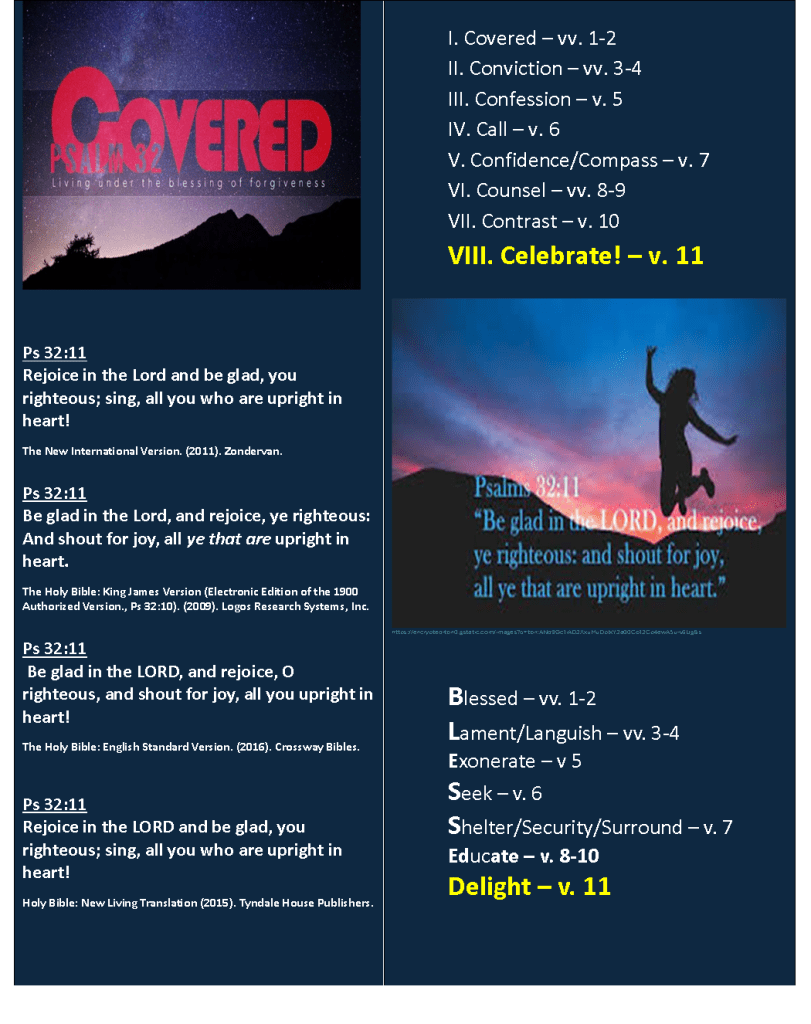
As I alluded to in my last Journal entry, the words I chose to use in my outlines on Psalm 32 reflect the “external reaction and internal response of God’s people to who God is and all that He has done.” I then recounted what I believed this Psalm revealed about who God is and the actions he takes towards His people and the “wicked.”

However, I want to return to the keywords found in verse 11. In verse 11, I believe David is using synonymous parallelism. A synonymous parallelism is:

A feature of biblical poetry where the successive lines repeat, reinforce, and expand on the previous line. Mangum, D. (2014). The Lexham Glossary of Theology. Lexham Press.

Thus, “Be glad in the LORD, and rejoice, O righteous,” is followed by the clause “and shout for joy, all you upright in heart!” Both are essentially saying the same thing, but the second clause in this case clarifies the action the “righteous” are exhorted to do.

Two verbs are imperatives: “Be glad” (“Delight” in my outline) and “rejoice”(“Celebrate”), which correspond with the phrase “shout for joy” in the second clause. The phrase “be glad,” to me, represents the internal feeling that overflows into the external response, which is to “rejoice.” But how are we to rejoice? The second clause tells us. We are to rejoice by shouting for joy*  (ESV, KJV, NIV) or singing (NIV).

I will not get bogged down here on why there is a difference in translation. Both translations are possible. In today’s church in America, we are more likely to sing than to shout in most settings. That may not be so in another part of the world, nor in the day when David lived. The point is that the internal gladness is not to be quenched, but to flow out into external, verbalized joy! Both in the “decently and in order” (1 Cor 14:40 ESV) of a Sunday service and spontaneously in our private devotions or amongst a small group of believers worshiping together.

Yet the how is not as important as the who. I’m not referring to the people doing the rejoicing – that is obviously the “upright in heart” – but the object of their shouting or singing. The Who here is the LORD (Yahweh). All our gladness and rejoicing are “in the LORD.” I believe this little phrase conveys more than just the object of our joyful worship; it also conveys the subject of our worship.

That God is the object and subject of our worship sounds too obvious to mention. However, how often do we place ourselves as the object in worship? You may ask, “When do we do that?” When we limit our worship to rejoicing only in what God has done for us, but fail to rejoice that He would even condescend to do anything for us at all. Worship that makes the LORD the object and subject is done in humble gratitude for the grace and mercy of God. Is that not one of the main points of Psalm 32?


*One word in Hebrew


Worship in Witness:

It isn’t easy to talk about rejoicing at the moment. My heart is grieving today over the loss of a Christian brother who was, first of all, a follower of Christ and outspoken in his sharing of the gospel to crowds of young people on college and university campuses. He was a devoted husband, father, and champion of the truth.  

I will not try to analyze the motives of those who are gleeful and celebrate the death of Charlie Kirk. Suffice it to say, it can be summed up by the motive of hate and a spiritual darkness that is spreading over this country, fueled by the chief architect of evil, the devil himself.

But joy and rejoicing cannot be the activity and attitude of God’s people only when things are going well. That is evident from this psalm (see verses 6-7) as well as the witness of the rest of Scripture. By example and by verse, the Bible reveals numerous instances of rejoicing, even in the most dire situations.

For Instance, the prophet Habakkuk trembled at the coming invasion of the land of Judah where he dwelt. Yet he was able to declare even in the midst of coming suffering, these words found in chapter 3:

      17 Though the fig tree does not bud

         and there are no grapes on the vines,

         though the olive crop fails

         and the fields produce no food,

         though there are no sheep in the pen

         and no cattle in the stalls,

      18 yet I will rejoice in the LORD,

         I will be joyful in God my Savior.

Hab 3:17–18 NIV (2011)

He could do this because of God’s actions in the past:

     2 LORD, I have heard of your fame;

         I stand in awe of your deeds, LORD.

        Hab 3:17–18 NIV (2011)

And thus he could pray:

        3 Repeat them in our day,

         in our time make them known;

         in wrath remember mercy.

                            Hab 3:17–18 NIV (2011)

And as he prayed, he burst out in a psalm of remembrance of God’s mighty acts in delivering His covenant people (see Habakkuk 3:3-15).

      12 In wrath you strode through the earth

         and in anger you threshed the nations.

      13 You came out to deliver your people,

         to save your anointed one.

                            Hab 3:12–13 NIV (2011)

It is good to recount the mighty acts of God, both from Scripture and from our own experiences. And not only of ours but from the lives of God’s people, both present and past. Therefore, it is good to recount so that we might be able to rejoice. The faithful acts of God for His people are the fuel that ignites our confident hope in the future. The certainty of the past, coupled with the promise of the future, then leads to perseverance in the present!

Finally, Habakkuk could rejoice because of who God is: “The Sovereign LORD” – and what he gives: “strength,” stability (“surefooted), and ability (“able to tread”)

  19 The Sovereign LORD is my strength!

      He makes me as surefooted as a deer,

      able to tread upon the heights.

              Hab 3:19 NLT (2015)

I could go on and on recounting those who were able to rejoice in times of sorrow or suffering. Of  the apostles in Acts 5:41 rejoicing even after being flogged at the command of the Sanhedrin:

They called the apostles in and had them flogged. Then they ordered them not to speak in the name of Jesus, and let them go.

41 The apostles left the Sanhedrin, rejoicing because they had been counted worthy of suffering disgrace for the Name. 42 Day after day, in the temple courts and from house to house, they never stopped teaching and proclaiming the good news that Jesus is the Christ. Acts 5:40b-42 NIV (1984)

Or how Paul and Silas, when beaten, put in stocks, and thrown in the depths of prison, could still worship:

22 The crowd joined in the attack against Paul and Silas, and the magistrates ordered them to be stripped and beaten. 23 After they had been severely flogged, they were thrown into prison, and the jailer was commanded to guard them carefully. 24 Upon receiving such orders, he put them in the inner cell and fastened their feet in the stocks.

25 About midnight Paul and Silas were praying and singing hymns to God, and the other prisoners were listening to them. Acts 16:22-25 NIV (1984)

And just one more example, because this section is growing quite long (add your own examples):

3 We put no stumbling block in anyone’s path, so that our ministry will not be discredited. 4 Rather, as servants of God we commend ourselves in every way: in great endurance; in troubles, hardships and distresses; 5 in beatings, imprisonments and riots; in hard work, sleepless nights and hunger; 6 in purity, understanding, patience and kindness; in the Holy Spirit and in sincere love; 7 in truthful speech and in the power of God; with weapons of righteousness in the right hand and in the left; 8 through glory and dishonor, bad report and good report; genuine, yet regarded as impostors; 9 known, yet regarded as unknown; dying, and yet we live on; beaten, and yet not killed; 10 sorrowful, yet always rejoicing; poor, yet making many rich; having nothing, and yet possessing everything. 2 Cor 6:3-10 NIV (1984)

These were all living out their lives in obedience to Scripture:

Let the righteous rejoice in the Lord
and take refuge in him;
let all the upright in heart praise him!
Ps 64:10 NIV

  • Despite the “evil plans… devised” by the “evil doers.” (See verses 1-9

Rejoice in the Lord always. I will say it again: Rejoice! Phil 4:4 NIV

  • Exhorts the Apostle Paul from prison

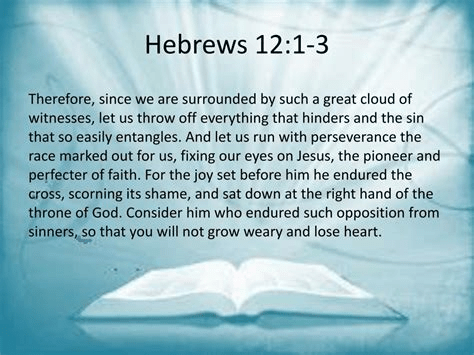
2 Consider it pure joy, my brothers, whenever you face trials of many kinds, 3 because you know that the testing of your faith develops perseverance. 4 Perseverance must finish its work so that you may be mature and complete, not lacking anything. James 1:2-5 NIV

  • Because suffering has a purpose

https://external-content.duckduckgo.com/iu/?u=https%3A%2F%2Ftse3.mm.bing.net%2Fth%2Fid%2FOIP.77KG5EY3G_gXrQ0r4CYOPQAAAA%3Fr%3D0%26pid%3DApi&f=1&ipt=a895040836f8f6b3e782242a09a262a69e7945f7089c889763aba0e5deb318bb&ipo=images


Witness in Promise, Poem, Prayer, and Praise

https://external-content.duckduckgo.com/iu/?u=https%3A%2F%2Ftse4.mm.bing.net%2Fth%2Fid%2FOIP.VwJRIE4gnv40rbt-yW5W3wHaE8%3Fr%3D0%26pid%3DApi&f=1&ipt=d53baeb33bb4000b56e9a36f71bb77078c1a15003acee325a16e529c8c94fe91&ipo=images

Lasting Glory
Trials will terminate
Suffering will cease
But oh, what lasting glory we will have
At the coming of the Prince of Peace

Mixed Tears

We shed tears when someone dies

Humanity mourns and humanity cries

But for believers, mixed with the tears are sorrow and joy

And a hope which death cannot destroy

Who sorrow not as those without hope

Without the Lord’s comfort to help them cope

But with the promise of resurrection and life eternal

They rejoice in hope of a future life supernal.

Amen

All Things

Lord,

All things are from Thy hand

Even the things I don’t understand

All my days are written by Thee

My life is embraced by Thy sovereignty

Days of pain

and

days of sadness

Days of gain

and

days of gladness

These are chapters in my story

All for my good and for THY GLORY!

Amen

With The Lord by NONAH

When you stand at Heaven’s gate
And the world is in the rear view
When you meet him face to face
And the sting of death’s behind you

When the pain you felt is left back in the grave
And you’re with the One for whom your soul has ached

You were made to dance
Forever in His hands
You don’t have to cry anymore
This is what He died for
You were made to fly
To look Him in the eyes
You don’t have to cry anymore
You’re with the Lord

You’ll behold the King of Kings
The Cornerstone of Zion
And for all eternity
You’ll praise the Lamb, the Lion

When the pain you felt is left back in the grave
And you’re with the one for whom your soul has ached

You were made to dance
Forever in His hands
You don’t have to cry anymore
This is what He died for
You were made to fly
To look Him in the eyes
You don’t have to cry anymore
You’re with the Lord

You’ll join the angels singing Holy, Holy
You’ll see the elders casting crowns, He is worthy
With all creation you’ll proclaim
He is glorious, glorious

You’ll join the angels singing Holy, Holy
You’ll see the elders casting crowns, He is worthy
With all creation you’ll proclaim
He is glorious, glorious

You were made to dance
Forever in His hands
You don’t have to cry anymore
You’re with the Lord

Video & Lyrics: https://youtu.be/gKj_xQDH1wc

When I heard this song on Spotify, I thought of Charlie Kirk and told myself to use this song at the end of my journal entry. I guess I wasn’t the only one who felt this way. The video was posted on September 11, one day after his assassination. Many of the comments made the same connection.


QUOTES:

Shout, O Israel! Rejoice and exult with all your heart. (Zeph. 3:14)

Rejoice greatly, O daughter of Zion! (Zech. 9:9)

Rejoice and be glad, for your reward is great in heaven. (Matt. 5:12)Rejoice that your names are written in heaven. (Luke 10:20)

Through him we have also obtained access by faith into this grace in which we stand, and we rejoice in hope of the glory of God. (Rom. 5:2)

Rejoice in hope, be patient in tribulation, be constant in prayer. (Rom. 12:12)

Rejoice with those who rejoice. (Rom. 12:15)

Likewise you also should be glad and rejoice with me. (Phil. 2:18)

Rejoice in the Lord always; again I will say, rejoice. (Phil. 4:4)

Rejoice always. (1 Thess. 5:16)

But rejoice insofar as you share Christ’s sufferings. (1 Pet. 4:13)

Let us rejoice and exult and give him the glory, for the marriage of the Lamb has come, and his Bride has made herself ready. (Rev. 19:7)

Finally, brothers, rejoice. (2 Cor. 13:11)

Wilson, J. C., & Chandler, M. (2012). Gospel deeps: reveling in the excellencies of Jesus. Crossway.


  Now I rejoice in my sufferings for your      Col 1:24    

  we rejoice before our God on your account,      1Th 3:9    

  Rejoice always;      1Th 5:16     

  In this you greatly rejoice,      1Pe 1:6     

  you greatly rejoice with joy      1Pe 1:8     

  glory you may rejoice with exultation.      1Pe 4:13     

  will rejoice over them and celebrate;      Rv 11:10     

  “For this reason, rejoice,      Rv 12:12    

  “Rejoice over her, O heaven, and you      Rv 18:20     

Thomas, R. L., The Lockman Foundation. (1998). New American Standard exhaustive concordance of the Bible: updated edition. Foundation Publications, Inc.