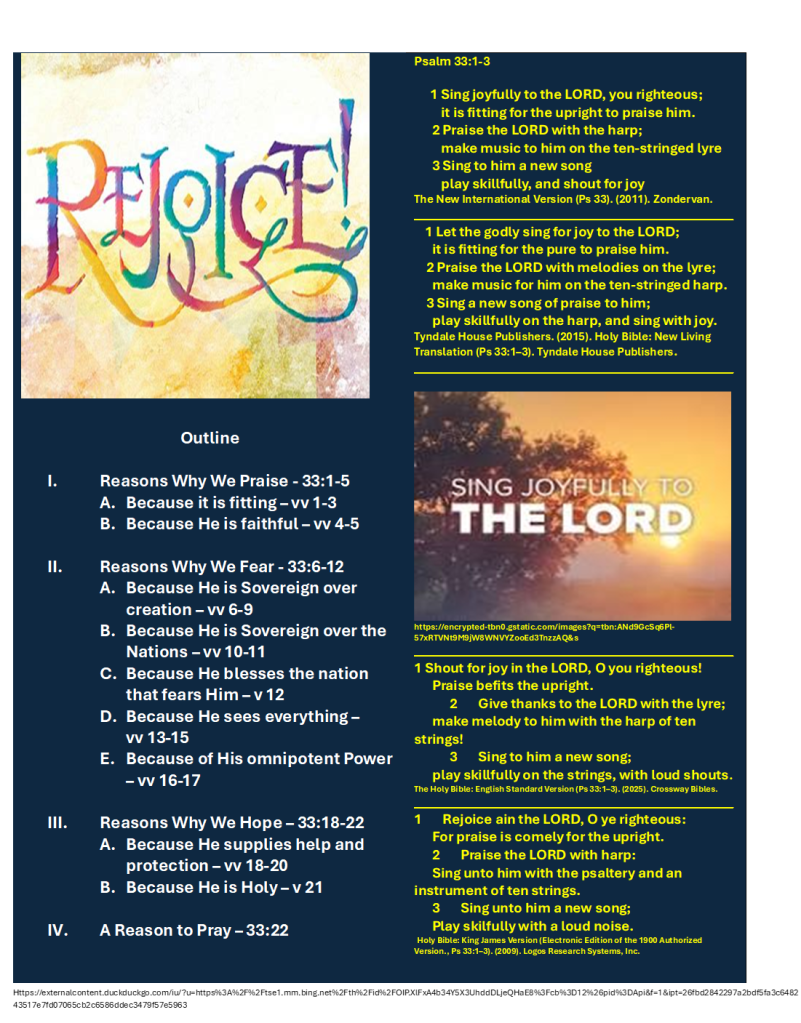
“We sing praise songs in church, but do we truly praise?”

Worship inthe Word

I. Reasons Why We Praise – 33:1-5

A. Because it is fitting – vv 1-3

B. Because He is faithful – vv 4-5

In my previous blog, I said this:

We could start by discussing whether the NIV’s translation of the Hebrew word rānah as “sing joyfully” is correct. Other versions translate it as “rejoice” (which conveys the emotion but not the method) or “shout” (which conveys the method, but not the emotion). But that discussion can come later.

I want to look at that issue right now. I looked up the words in the first three verses related to praise, and made a little chart.                                                                                                     

VerseStrongs #HebrewNIVESVNLTKJV
1a7442ranansing Joyfullyshout for joyshout for joyrejoice
1b8416tehillahpraisepraisepraisepraise
23034yadahpraisegive thankspraisepraise
3a7891shyirsingsingsingsing
3b8643teruw`ahshoutloud shoutsing with joyloud noise

You can see how each version translates the Hebrew word or words used in each verse. Although the English versions show eight variations, they generally focus on three actions: sing, shout, and praise—with a couple of exceptions. In verse 2, the ESV renders yadah as “give thanks,” while the NIV, NLT, and KJV use “praise.” For verse 3b, the NLT says “sing with joy,” whereas the other translations highlight a sense of loudness. All versions are consistent with one another in only two verses. In verse 1b, each employs the English term “praise,” and in verse 3a, all utilize the term “sing.” Verse 2 is similar; however, the ESV renders yadah differently.1

As you can see, there are five different Hebrew words used in these three verses, but they have been translated eight different ways between all four versions. I’d prefer not to spend too much time thoroughly exploring how these words can be translated. Upon reviewing multiple reference sources regarding each term, it becomes evident that reasonable arguments exist in support of all of them. I have given the Strong’s #s where you can study further if you have that resource, as well as more extensive reference works that also use the Strong’s numbering system.2

Many of you are scratching your heads by now. Why go to all this trouble? After all, when you boil it down, they are all conveying the same message. Praise should be joyous and often coupled with gusto (i.e., “shout” or “loud”). However, Psalm 33:1-3 should not be used as a prooftext for how worship should be practised. Rather, we can glean principles to apply in our own time and setting.

Worship inWitness

If praise is “fitting” for the “upright,” then it should be done in a fitting manner. Can one praise without joy in their soul? We must distinguish a praise song from a song sung in praise. The term “praise song” has come to refer to a specific style of song. But even those “praise” songs can be sung mindlessly and without joy. It’s not about style but about sincerity.

Take a well-known hymn, “Holy, Holy, Holy.” Most Christians can probably sing this without a hymnal or on a screen. They have memorized it by heart, but may lack genuine feeling—a heart meant for praise can also be empty of joy. Even when the words come easily, the heart might remain untouched. Sometimes, a heart can echo with ritual yet never awaken to true delight. And if you ask many Christians to name a praise song, this hymn will most likely not make the list, even if you are more “traditional” in your worship service.

Humans have a natural tendency to categorize. However, classifying songs—much like reciting them mechanically—does not necessarily ensure genuine engagement in the manner intended by the composer. It’s common to ask, “What songs did you sing in church today?” with someone replying, “We sang some great praise songs.” Afterward, they may leave feeling they’ve completed everything: attended the service – check, sang praise songs – check, worshipped – check, and listened to the Word preached – check.

A better question we should ask and answer ourselves is, “Did I sing with a sincere heart of joy and thanksgiving?” If the answer is, “not really,” then we cannot say we “sang a lot of praise songs.” Because the external arrangement of notes or words is meaningless, if we have sung only for our personal pleasure and fulfillment, let us instead pursue an internal attitude of joy directed towards our glorious Lord.

There’s still much to discuss, but I will save it for my next journal entry. I hope to deepen my self-reflection regarding praise, as I also need to address the questions raised earlier.

Worship in Promise, Poem, Prayer, and Praise
http://godsbigshow.blogspot.com/2018/06/do-what-lord-say-do-clarence-fountain.html

Why Do I?

Why is it so

To church, I go?

Is it to know?

Is it to grow?

Is it for show?

Why do I praise

With hands upraised?

A heart ablaze?

A mind amazed?

For others to agaze?

Why do I serve

Without reserve?

Grace undeserved?

Grace filled verve?

To be observed?

Without Measure

Triune God,

Fill me with joy in my soul

That I may praise You with gladness

Even when sorrow would have me faint with sadness

Remind me of Your grace and mercy

Tell me again of Your endless loving-kindness

Enlighten the eyes of my heart, remove its blindness

May this prayer not end with a focus on me

Nor on my personal petitions for self-edification and pleasure

But in You be all my glory and praise, my Lord and God, my Savior, my treasure

~ Amen

Holy, Holy, Holy by Reginald Heber (1826) tune “Nicaea,” by John Bacchus Dykes (1861)

  1. Holy, holy, holy! Lord God Almighty!
    Early in the morning our song shall rise to Thee;
    Holy, holy, holy, merciful and mighty!
    God in three Persons, blessed Trinity!
  2. Holy, holy, holy! All the saints adore Thee,
    Casting down their golden crowns around the glassy sea;
    Cherubim and seraphim falling down before Thee,
    Who was, and is, and evermore shall be.
  3. Holy, holy, holy! Though the darkness hide Thee,
    Though the eye of sinful man Thy glory may not see;
    Only Thou art holy; there is none beside Thee,
    Perfect in pow’r, in love, and purity.
  4. Holy, holy, holy! Lord God Almighty!
    All Thy works shall praise Thy Name, in earth, and sky, and sea;
    Holy, holy, holy; merciful and mighty!
    God in three Persons, blessed Trinity!

Lyrics: https://library.timelesstruths.org/music/Holy_Holy_Holy/

Video to sing by: https://youtu.be/zzM9P_Gqw-s

Below are two videos I discovered while looking for a video for Holy, Holy, Holy. They are two videos sung by the same people, but the first one doesn’t have the lyrics shown while singing. The second one does. The first one is great for sitting back, closing your eyes, listening to the lyrics, and perhaps using your imagination. The second is great if you want to see the actual lyrics in English and Hebrew. Just click on them and they will play. This is a long song (over 11 minutes), but it’s worth listening to!

NOTES & QUOTES :

1 The Hebrew word yadah, translated as “Give thanks” by the ESV, conveys both Praise and Thanks. Most reference works available to me prefer to translate it as “praise.” One such resource, after discussing one of the meanings of this word, says: (You can skip down to the highlighted sentence if you are not interested in the technical jargon)

“Second, this verb was predominantly employed to express one’s public proclamation or declaration (confession) of God’s attributes and his works. This concept is at the heart of the meaning of praise. Praise is a confession or declaration of who God is and what he does. This term is most often translated “to thank” in English versions, but such is not really a proper rendering according to Westermann: In the Old Testament… there is as yet no verb that means only “to thank.” Yadah, which is usually translated as “to thank,” is not used in the Old Testament a single time for an expression of thanks between men. Thus, it is clear from the start that this yadah

cannot be equated with our “to thank,” which can be directed equally to God and to man. In those places in the O.T. where our “thank” as something taking place between men is most clearly found, the verb used is

barak, which does not have the primary meaning of “praise” but means “bless.” 

In view of these facts, it is clear that the O.T. does not have our independent concept of thanks. The expression of thanks to God is included in praise, it is a way of praising.” (Westermann, Claus. The Praise of God in the Psalms. Richmond: John Knox Press, 1965, pp, 26-27.) (from Theological Wordbook of the Old Testament. Copyright © 1980 by The Moody Bible Institute of Chicago. All rights reserved. Used by permission.) 

2 I use Logos software, which is an excellent resource. Their software packages can be costly and may be more than you need. They offer online subscriptions that are much more affordable. I have the Max Pro subscription, but they also offer lower-priced options that will probably meet all your needs. https://www.logos.com/configure/subscriptions?trackId=191
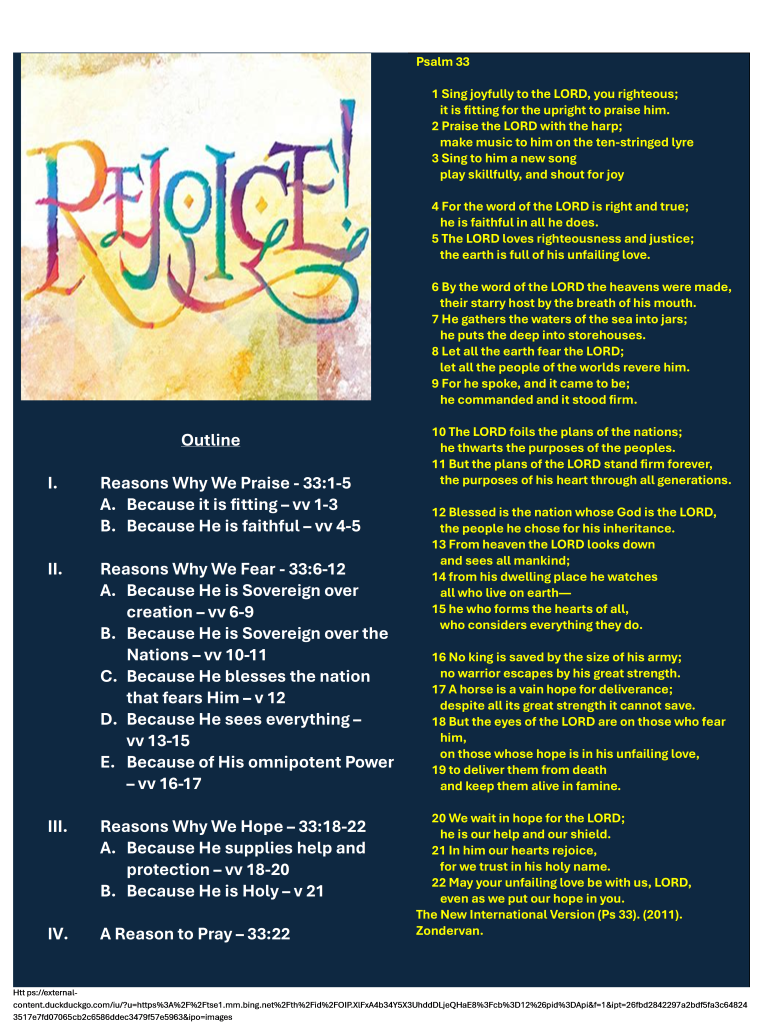

Praise is Fitting and Beautiful

Worship in the Word

I. Reasons Why We Praise – 33:1-5

A. Because it is fitting – vv 1-3

B. Because He is faithful – vv 4-5

Not all the reasons, of course, but reasons stated in the first 5 verses of Psalm 33. I say stated, because there are many reasons implied throughout the Psalm. Even the subpoints under the headings aren’t exhaustive or consistent. For example, the subheadings under the first heading covering verses 1-5 need to be expanded on. And as you see, I used alliteration. In contrast, the subheadings under II-IV are not alliterative. But that’s enough clarification and self-criticism.

We could start by discussing whether the NIV’s translation of the Hebrew word rānah as “sing joyfully” is correct. Other versions translate it as “rejoice” (which conveys the emotion but not the method) or “shout” (which conveys the method, but not the emotion). But that discussion can come later.

I want to focus on the Hebrew word nāʾweh, which is translated as “fitting.” If you consult various translations, you will find that you can break them down into two basic adjectives: one that describes its appearance, and the other that describes its appropriateness or suitability. Versions like the CSB (Christian Standard Bible) translate nāʾweh as “beautiful,” which corresponds to the first description (appearance). While others, such as the NIV, render it as “fitting,” which corresponds to the second description (suitability). The KJV uses the word “comely,” a word not used much, if at all, today. It also refers to the attractiveness of a person or activity, though it can, secondarily, mean ‘proper’. The Amplified version incorporates both meanings in its translation of verse one: “praise is becoming and appropriate” – AMP (Amplified). Though the word “becoming” can refer to something that is either attractive or appropriate.

A look at Hebrew dictionaries and lexicons doesn’t shed much light on the matter, since the word is used elsewhere with one or the other meaning in mind. The only other passage in the Psalms faces the same translational variances (see Psalm 147:1 NIV, NASB) . Passages outside the Psalms don’t help either. Some contexts demand that it be translated as lovely or beautiful (E.g., Song of Songs 2:14). In contrast, others require the meaning of fitting or appropriate (e.g., Prov. 17:7). However, in the case of Psalm 33:1, both meanings are possible.

Instead of getting bogged down in the arguments for why it should be translated one way or the other, I am going to say that both meanings are “fitting” for God’s people (“the upright”). That to sing or shout out our praise is both beautiful and appropriate in our worship (“decently and in order,” of course-1 Cor. 14:40). I say “our” in a corporate sense, though private praise is fitting and beautiful too. But here, the psalmist is exhorting the “righteous” (plural in Hebrew) to worship the Lord.

Sing joyfully to the Lord, you righteous – Ps 33:2 NIV (2011)

Many today who claim to be Christians say, “I don’t have to go to church; I can worship at home or out in nature.” Worshipping at home and out in God’s wonderful creation is undoubtedly good, helpful, and edifying. However, Scripture also exhorts us to meet together in shared fellowship.

Worship in Witness

I recently read an article that said Gen Z  and millennials were returning to church. Yet, when you dig into the article, you discover that the average attendance has risen to 1.8 or 1.9 times per month, meaning less than half of the month. And this was contrasted with COVID-19 attendance, during which many churches were shut down. When I was attending Bible College back in the 1970’s, there was the running joke about people attending “Bedside Baptist” or “Parkway Presbyterian.” Many disregard the exhortation in Hebrews not to forsake “the assembling of ourselves together” (Heb 10:25 KJV).

The ESV translates this verse this way:

not neglecting to meet together, as is the habit of some, but encouraging one another, and all the more as you see the Day drawing near. The Holy Bible: English Standard Version (Heb 10:25). (2025). Crossway Bibles.

Verse 25 serves as the instrumental means to fulfill the exhortation found in verse 24:

And let us consider how to stir up one another to love and good works,

Verse 25 tells us how to accomplish the exhortation given in verse 24. How are we to “stir up one another to love and good works?” The comma at the end of verse 24 in the ESV points to verse 25, which tells us that we do this through our meeting together and “encouraging one another.” But note that there were some whose “habit” was to ignore or avoid joining in their local fellowship of believers, as it is today, sadly.

What is more “befitting” or “beautiful” than when the blood-bought body of Christ comes together and worships the Lord through the preaching of God’s word? Where we sit, as it were, at the feet of Jesus, having chosen the “good part,” “right thing,” or the “best part” (see Luke 10:42).

What is more appropriate or attractive when God’s family joins together in praise?

Praise the Lord! For it is good to sing praises to our God; for it is pleasant, and a song of praise is fitting. Psalm 147:1 ESV

Praising God takes our eyes off our problems and onto the Lord, in whose hands we are held (see John 10:27-30). Who works all things out for His glory and our good (see Rom 8:26-31). Who is both our Sovereign Lord (see Isaiah 46:9-10 and sympathizing Savior (see Hebrews 4:14-16 ESV, NLT).*

For we do not have a high priest who is unable to sympathize with our weaknesses, but one who in every respect has been tempted as we are, yet without sin.

Hebrews 4:14-16 ESV*

And it not only exalts God, but it is a means of grace by which God edifies us. Colossians 3:16 sums up the beauty, benefit, and befittingness of the ministry of preaching and of praise.

Let the word of Christ dwell in you richly, teaching and admonishing one another in all wisdom, singing psalms and hymns and spiritual songs, with thankfulness in your hearts to God.

ESV (see also 1 Cor. 14:26)

Hebrews 10:24-25 shows us the goal of fellowship: to “grow in love and good works.” We do this in light of “the day” (see Mt 24:44). That is, in light of the imminent return of the Lord in “an hour” we “do not expect”, which encourages us to be found worshipping and working for the Lord when He comes. It also reminds us that there is strength in numbers. An ember separated from the fire will soon go out. Habitually avoiding Christian fellowship can lead to depression and loneliness. It also reveals what we value most.

For where your treasure is, there your heart will be also. – Matt 6:21 NIV

But meeting together with other believers can have the same results as not attending. If we are not open to giving and receiving encouragement, or if our services are not conducive to achieving this, the results will be the same. Furthermore, if we only go to revel in the pleasure of enjoying the music, song, and preaching for ourselves, we may go home “blessed.” But we will not bless anyone else. How many times have you heard someone say, “I like going to church because it just makes me feel good?” I call them (and myself sometimes?) Dead Sea Attendees. Like the Dead Sea, where the water flows in but has no outlet. And they cannot sink because of the water’s saltiness. They take it all in and float all the way home. However, they never allow it flow out to help a brother or sister who is drowning in their sorrows, sins, and struggles.

Returning to Psalm 33:1, we can now see that the participle “fitting” serves to describe the need and necessity of praise in the life of the believer, both personally and corporately in the body of Christ. I believe this one word prompts the Bible explorer to look further along the path to find out why it is “fitting” and “beautiful.” A path that leads through the rest of Psalm 33 (and throughout all of Scripture) to find the treasure buried in this one single Hebrew word: “nāʾweh.”

*Some translations, like the ESV, render the Greek word πειράζω (peirazō) as ‘tempt’ or ‘tempted’.     Other versions, like the NLT, have ‘test’ or ‘tested’. Both are possible, and perhaps the author of Hebrews meant both meanings, for surely both are true. Truly, our Lord is a sympathizing Savior in both the testing and the tempting we face. Hallelujah

Worshipin Promise, Poem, and Praise

Burning Coals

O Christian, you are burning coal

Aflame with a loving fire

With an all-consuming goal

To encourage and inspire

But like a coal that falls away

This truth you must remember

When you choose to go astray

You become a dying ember

Not Just a Duty

Our praise to the Lord is befitting,

The One who on His eternal throne is sitting

Our worship is a thing of beauty,

and not just a Christian’s duty

Stir the Fire by Faithful Song

Let us stir the fire, let us fan the flame

Calling every heart by Jesus name.

Not alone in faith, we walk side by side

Lifting one another with hearts open wide

Let us gather, let us praise

In one spirit, Lift his name

Not forsaking sacred time

But meeting with the love divine

Let us gather, let us see

What God can do in you and me

As the Day is drawing near

Let us stand in love, not fear

Let us speak with grace, let our hands reach out

Building up the weary, casting doubt

In the house of God, there’s strength to rise

Together we shine like morning skies

Let us gather, let us praise

In one spirit, lift his name

Not forsaking sacred time

But meeting with the love divine

Let us gather, let us see

What God can do in you and me

As the day is drawing near

Let us stand in love, not fear

Every soul, come take your place

There is mercy, there is grace

Don’t give up, keep holding on

We are weak, but He is strong

Let us gather, let us praise

In one spirit, lift his name

Not forsaking sacred time

But meeting with the love divine

Let us gather, let us shine

With his purpose, His design

Till the trumpet sound we hear

Let us stand in love, not fear

Music Video & Lyrics: https://youtu.be/T5hEFL7Rc_c

Here is a great song I’ve never heard, and I don’t think many have either. Yet I believe it will bless and encourage you. I had to transcribe the lyrics from the transcription. That was provided on the web page.

QUOTES:

Song and praise, thanksgiving (praise, ‘give thanks’), instrumental music, and loud acclamation (shout for joy, ‘with a loud shout’)—all make their contribution to a fitting response to the Lord from those who are right with him (righteous) in heart and upright before him in life.

Motyer, J. A. (1994). The Psalms. In D. A. Carson, R. T. France, J. A. Motyer, & G. J. Wenham (Eds.), New Bible commentary: 21st century edition (4th ed., pp. 505–517). Inter-Varsity Press.

Worship is “becoming” or “fitting” (v. 1a) for two reasons: first, because of who God is, and second, because of who we are; i.e., we were created to worship.

Storms, S. (2016). Biblical Studies: Psalms (Ps 33:1–3). Sam Storms.

NITZSCH: The glorifying of God our Saviour by the new songs, which He has awakened from the earliest times in His congregation. These songs glorify Him, 1) by virtue of their origin, since they come only from a newly created heart which is full of salvation; 2) by means of their meaning and contents as the signs of the highest satisfaction, which it is possible for men to attain here below, 3) by means of their long and deep effect upon the present and future; 4) as the living alliance of the saints with the lovely and beautiful.

Lange, J. P., Schaff, P., Moll, C. B., Briggs, C. A., Forsyth, J., Hammond, J. B., McCurdy, J. F., & Conant, T. J. (2008). A commentary on the Holy Scriptures: Psalms (p. 233). Logos Bible Software.