Who is the Object and Subject of Your Worship?

ImageofPsalm32: https://external-content.duckduckgo.com/iu/?u=https%3A%2F%2Ftse1.mm.bing.net%2Fth%3Fid%3DOIP.uON7w9dj7h9bbyAywUxbxwHaHa%26pid%3DApi&f=1&ipt=81601b2971ec139f1452cc5a9f188f97132eb9656a7ee99e8a69ae2eb0911ee7&ipo=images

Worship in Word:

As I alluded to in my last Journal entry, the words I chose to use in my outlines on Psalm 32 reflect the “external reaction and internal response of God’s people to who God is and all that He has done.” I then recounted what I believed this Psalm revealed about who God is and the actions he takes towards His people and the “wicked.”

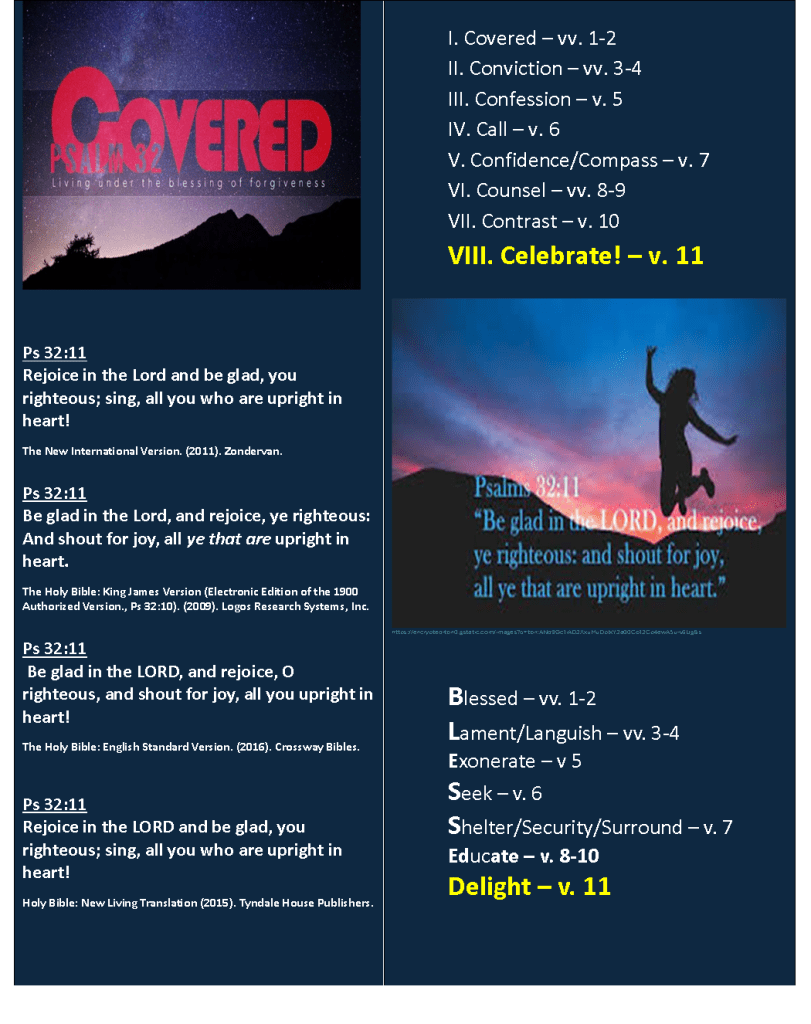
However, I want to return to the keywords found in verse 11. In verse 11, I believe David is using synonymous parallelism. A synonymous parallelism is:

A feature of biblical poetry where the successive lines repeat, reinforce, and expand on the previous line. Mangum, D. (2014). The Lexham Glossary of Theology. Lexham Press.

Thus, “Be glad in the LORD, and rejoice, O righteous,” is followed by the clause “and shout for joy, all you upright in heart!” Both are essentially saying the same thing, but the second clause in this case clarifies the action the “righteous” are exhorted to do.

Two verbs are imperatives: “Be glad” (“Delight” in my outline) and “rejoice”(“Celebrate”), which correspond with the phrase “shout for joy” in the second clause. The phrase “be glad,” to me, represents the internal feeling that overflows into the external response, which is to “rejoice.” But how are we to rejoice? The second clause tells us. We are to rejoice by shouting for joy*  (ESV, KJV, NIV) or singing (NIV).

I will not get bogged down here on why there is a difference in translation. Both translations are possible. In today’s church in America, we are more likely to sing than to shout in most settings. That may not be so in another part of the world, nor in the day when David lived. The point is that the internal gladness is not to be quenched, but to flow out into external, verbalized joy! Both in the “decently and in order” (1 Cor 14:40 ESV) of a Sunday service and spontaneously in our private devotions or amongst a small group of believers worshiping together.

Yet the how is not as important as the who. I’m not referring to the people doing the rejoicing – that is obviously the “upright in heart” – but the object of their shouting or singing. The Who here is the LORD (Yahweh). All our gladness and rejoicing are “in the LORD.” I believe this little phrase conveys more than just the object of our joyful worship; it also conveys the subject of our worship.

That God is the object and subject of our worship sounds too obvious to mention. However, how often do we place ourselves as the object in worship? You may ask, “When do we do that?” When we limit our worship to rejoicing only in what God has done for us, but fail to rejoice that He would even condescend to do anything for us at all. Worship that makes the LORD the object and subject is done in humble gratitude for the grace and mercy of God. Is that not one of the main points of Psalm 32?


*One word in Hebrew


Worship in Witness:

It isn’t easy to talk about rejoicing at the moment. My heart is grieving today over the loss of a Christian brother who was, first of all, a follower of Christ and outspoken in his sharing of the gospel to crowds of young people on college and university campuses. He was a devoted husband, father, and champion of the truth.  

I will not try to analyze the motives of those who are gleeful and celebrate the death of Charlie Kirk. Suffice it to say, it can be summed up by the motive of hate and a spiritual darkness that is spreading over this country, fueled by the chief architect of evil, the devil himself.

But joy and rejoicing cannot be the activity and attitude of God’s people only when things are going well. That is evident from this psalm (see verses 6-7) as well as the witness of the rest of Scripture. By example and by verse, the Bible reveals numerous instances of rejoicing, even in the most dire situations.

For Instance, the prophet Habakkuk trembled at the coming invasion of the land of Judah where he dwelt. Yet he was able to declare even in the midst of coming suffering, these words found in chapter 3:

      17 Though the fig tree does not bud

         and there are no grapes on the vines,

         though the olive crop fails

         and the fields produce no food,

         though there are no sheep in the pen

         and no cattle in the stalls,

      18 yet I will rejoice in the LORD,

         I will be joyful in God my Savior.

Hab 3:17–18 NIV (2011)

He could do this because of God’s actions in the past:

     2 LORD, I have heard of your fame;

         I stand in awe of your deeds, LORD.

        Hab 3:17–18 NIV (2011)

And thus he could pray:

        3 Repeat them in our day,

         in our time make them known;

         in wrath remember mercy.

                            Hab 3:17–18 NIV (2011)

And as he prayed, he burst out in a psalm of remembrance of God’s mighty acts in delivering His covenant people (see Habakkuk 3:3-15).

      12 In wrath you strode through the earth

         and in anger you threshed the nations.

      13 You came out to deliver your people,

         to save your anointed one.

                            Hab 3:12–13 NIV (2011)

It is good to recount the mighty acts of God, both from Scripture and from our own experiences. And not only of ours but from the lives of God’s people, both present and past. Therefore, it is good to recount so that we might be able to rejoice. The faithful acts of God for His people are the fuel that ignites our confident hope in the future. The certainty of the past, coupled with the promise of the future, then leads to perseverance in the present!

Finally, Habakkuk could rejoice because of who God is: “The Sovereign LORD” – and what he gives: “strength,” stability (“surefooted), and ability (“able to tread”)

  19 The Sovereign LORD is my strength!

      He makes me as surefooted as a deer,

      able to tread upon the heights.

              Hab 3:19 NLT (2015)

I could go on and on recounting those who were able to rejoice in times of sorrow or suffering. Of  the apostles in Acts 5:41 rejoicing even after being flogged at the command of the Sanhedrin:

They called the apostles in and had them flogged. Then they ordered them not to speak in the name of Jesus, and let them go.

41 The apostles left the Sanhedrin, rejoicing because they had been counted worthy of suffering disgrace for the Name. 42 Day after day, in the temple courts and from house to house, they never stopped teaching and proclaiming the good news that Jesus is the Christ. Acts 5:40b-42 NIV (1984)

Or how Paul and Silas, when beaten, put in stocks, and thrown in the depths of prison, could still worship:

22 The crowd joined in the attack against Paul and Silas, and the magistrates ordered them to be stripped and beaten. 23 After they had been severely flogged, they were thrown into prison, and the jailer was commanded to guard them carefully. 24 Upon receiving such orders, he put them in the inner cell and fastened their feet in the stocks.

25 About midnight Paul and Silas were praying and singing hymns to God, and the other prisoners were listening to them. Acts 16:22-25 NIV (1984)

And just one more example, because this section is growing quite long (add your own examples):

3 We put no stumbling block in anyone’s path, so that our ministry will not be discredited. 4 Rather, as servants of God we commend ourselves in every way: in great endurance; in troubles, hardships and distresses; 5 in beatings, imprisonments and riots; in hard work, sleepless nights and hunger; 6 in purity, understanding, patience and kindness; in the Holy Spirit and in sincere love; 7 in truthful speech and in the power of God; with weapons of righteousness in the right hand and in the left; 8 through glory and dishonor, bad report and good report; genuine, yet regarded as impostors; 9 known, yet regarded as unknown; dying, and yet we live on; beaten, and yet not killed; 10 sorrowful, yet always rejoicing; poor, yet making many rich; having nothing, and yet possessing everything. 2 Cor 6:3-10 NIV (1984)

These were all living out their lives in obedience to Scripture:

Let the righteous rejoice in the Lord
and take refuge in him;
let all the upright in heart praise him!
Ps 64:10 NIV

  • Despite the “evil plans… devised” by the “evil doers.” (See verses 1-9

Rejoice in the Lord always. I will say it again: Rejoice! Phil 4:4 NIV

  • Exhorts the Apostle Paul from prison

2 Consider it pure joy, my brothers, whenever you face trials of many kinds, 3 because you know that the testing of your faith develops perseverance. 4 Perseverance must finish its work so that you may be mature and complete, not lacking anything. James 1:2-5 NIV

  • Because suffering has a purpose

https://external-content.duckduckgo.com/iu/?u=https%3A%2F%2Ftse3.mm.bing.net%2Fth%2Fid%2FOIP.77KG5EY3G_gXrQ0r4CYOPQAAAA%3Fr%3D0%26pid%3DApi&f=1&ipt=a895040836f8f6b3e782242a09a262a69e7945f7089c889763aba0e5deb318bb&ipo=images


Witness in Promise, Poem, Prayer, and Praise
https://external-content.duckduckgo.com/iu/?u=https%3A%2F%2Ftse4.mm.bing.net%2Fth%2Fid%2FOIP.VwJRIE4gnv40rbt-yW5W3wHaE8%3Fr%3D0%26pid%3DApi&f=1&ipt=d53baeb33bb4000b56e9a36f71bb77078c1a15003acee325a16e529c8c94fe91&ipo=images

Lasting Glory
Trials will terminate
Suffering will cease
But oh, what lasting glory we will have
At the coming of the Prince of Peace

Mixed Tears

We shed tears when someone dies

Humanity mourns and humanity cries

But for believers, mixed with the tears are sorrow and joy

And a hope which death cannot destroy

Who sorrow not as those without hope

Without the Lord’s comfort to help them cope

But with the promise of resurrection and life eternal

They rejoice in hope of a future life supernal.

Amen

All Things

Lord,

All things are from Thy hand

Even the things I don’t understand

All my days are written by Thee

My life is embraced by Thy sovereignty

Days of pain

and

days of sadness

Days of gain

and

days of gladness

These are chapters in my story

All for my good and for THY GLORY!

Amen

With The Lord by NONAH

When you stand at Heaven’s gate
And the world is in the rear view
When you meet him face to face
And the sting of death’s behind you

When the pain you felt is left back in the grave
And you’re with the One for whom your soul has ached

You were made to dance
Forever in His hands
You don’t have to cry anymore
This is what He died for
You were made to fly
To look Him in the eyes
You don’t have to cry anymore
You’re with the Lord

You’ll behold the King of Kings
The Cornerstone of Zion
And for all eternity
You’ll praise the Lamb, the Lion

When the pain you felt is left back in the grave
And you’re with the one for whom your soul has ached

You were made to dance
Forever in His hands
You don’t have to cry anymore
This is what He died for
You were made to fly
To look Him in the eyes
You don’t have to cry anymore
You’re with the Lord

You’ll join the angels singing Holy, Holy
You’ll see the elders casting crowns, He is worthy
With all creation you’ll proclaim
He is glorious, glorious

You’ll join the angels singing Holy, Holy
You’ll see the elders casting crowns, He is worthy
With all creation you’ll proclaim
He is glorious, glorious

You were made to dance
Forever in His hands
You don’t have to cry anymore
You’re with the Lord

Video & Lyrics: https://youtu.be/gKj_xQDH1wc

When I heard this song on Spotify, I thought of Charlie Kirk and told myself to use this song at the end of my journal entry. I guess I wasn’t the only one who felt this way. The video was posted on September 11, one day after his assassination. Many of the comments made the same connection.


QUOTES:

Shout, O Israel! Rejoice and exult with all your heart. (Zeph. 3:14)

Rejoice greatly, O daughter of Zion! (Zech. 9:9)

Rejoice and be glad, for your reward is great in heaven. (Matt. 5:12)Rejoice that your names are written in heaven. (Luke 10:20)

Through him we have also obtained access by faith into this grace in which we stand, and we rejoice in hope of the glory of God. (Rom. 5:2)

Rejoice in hope, be patient in tribulation, be constant in prayer. (Rom. 12:12)

Rejoice with those who rejoice. (Rom. 12:15)

Likewise you also should be glad and rejoice with me. (Phil. 2:18)

Rejoice in the Lord always; again I will say, rejoice. (Phil. 4:4)

Rejoice always. (1 Thess. 5:16)

But rejoice insofar as you share Christ’s sufferings. (1 Pet. 4:13)

Let us rejoice and exult and give him the glory, for the marriage of the Lamb has come, and his Bride has made herself ready. (Rev. 19:7)

Finally, brothers, rejoice. (2 Cor. 13:11)

Wilson, J. C., & Chandler, M. (2012). Gospel deeps: reveling in the excellencies of Jesus. Crossway.


  Now I rejoice in my sufferings for your      Col 1:24    

  we rejoice before our God on your account,      1Th 3:9    

  Rejoice always;      1Th 5:16     

  In this you greatly rejoice,      1Pe 1:6     

  you greatly rejoice with joy      1Pe 1:8     

  glory you may rejoice with exultation.      1Pe 4:13     

  will rejoice over them and celebrate;      Rv 11:10     

  “For this reason, rejoice,      Rv 12:12    

  “Rejoice over her, O heaven, and you      Rv 18:20     

Thomas, R. L., The Lockman Foundation. (1998). New American Standard exhaustive concordance of the Bible: updated edition. Foundation Publications, Inc.
As We Walk, Let Us Worship!

ImageofPsalm32: https://external-content.duckduckgo.com/iu/?u=https%3A%2F%2Ftse1.mm.bing.net%2Fth%3Fid%3DOIP.uON7w9dj7h9bbyAywUxbxwHaHa%26pid%3DApi&f=1&ipt=81601b2971ec139f1452cc5a9f188f97132eb9656a7ee99e8a69ae2eb0911ee7&ipo=images


Worship in Word:

VIII. Celebrate, Delight, v. 11

The two words employed in the final heading of my outline describe the external reaction and internal response of God’s people to who God is and all that He has done.

God Is:

  • Gracious and Forgiving – vv. 1-3
  • A Disciplining Father – vv. 4-5
  • The One who hears the prayers of His people – vv. 6-7
  • Our Teacher and Counselor – vv. 8-9
  • Steadfast and Faithful in His wrath and love – v. 10
  •  The Object and Subject of our worship – v. 11

God Does:

  • Forgive and Bless the sinner who repents, confesses, and trusts in Him – vv. 1-5, 10
  • Pursues His erring ones – vv. 4-5
  • Rescue and Protect those who call upon Him in troubling times – vv. 6-7
  • Teach and Counsel His people who are willing to be taught – vv. 8-9
  • Punish the wicked, but surround His people with steadfast, unfailing, and faithful love. – vv. 10
  • Receive our worship and fill us with gladness and joy – vv. 11

God naturally does what He does because of who He is. God’s people should also naturally respond in worship because of who they are in Him.

Worship in Witness:

Recently I had to deliver a car to one of my sons who lives in another state. Of course, because I drove down, I had to purchase a one-way flight home. During my flight back home, I decided to refresh my memory and read my journal entries for this Psalm. It takes me so long to finish each Psalm that I sometimes have to go back and reread what I wrote. It seems miles apart from when I began my journey through Psalm 32, though it only takes a little more than a minute to read it out loud.

As I was reading, I came across this prayer I wrote near the beginning of my adventure through this Psalm. The substance of the prayer can be found in many places throughout my journey through the Psalms, as recorded in my journal—one reason why it takes so long to finish each journal entry. Journal entries are supposed to be daily, but I often take months to complete one entry. Of course, the nature and design of my journal entries cannot be completed in a day, but it should not take months, and sometimes over a year, to study one Psalm.

I retired several weeks ago. I now have a lot of time to work on my journal. Yet this is only the second time I have attempted to complete this entry. May this prayer, which I wrote a long time ago, now be a fresh confession, petition, and testament. Amen

Lord,

I turn to You, my strength and source of joy. I confess my lack of desire and lazy ways. I confess that my desire for earthly things – food, political issues, and financial security – consumes too much of my time. I envy others who seem to be enjoying themselves without thinking of the need for the deep study of Your word. And I feel the world’s pull – watch this… taste this… think this way… do this. It seems like I am surrounded by one colossal advertising scheme that seeks to lure me away from You. But I confess, Lord, it is working. I’m drawn away by phone notifications, numerous emails, finances, and even food preparation. I pray that envy, guilt, and inertia will give way to joy, delight, and desire. Because I know when I am drawn away by these things, it is because I want to be. No excuses, Lord. I am guilty. But I am reminded by this very psalm of what You have done for me. Chill bumps run up my arms as You remind me that Your grace has justified me! I AM BLESSED!


Yet, I cannot leave it there. Chill bumps are temporary and subside quickly. Memories of God’s grace can fade rapidly amid life’s distractions. God’s blessings can lose their luster and be taken for granted. I was reminded again of the title of a book I read many years ago. It was titled “A Long Obedience in the Same Direction: Discipleship in an Instant Society” by Eugene H. Peterson. My pastor mentioned it during the invitation last Sunday.

The life of grace and blessing is a long journey punctuated by times of “chills, thrills, and spills.” Along its path, we will stumble, but we must not stop or retreat. We must press on in obedience to His commands. One of those commands is found in Psalm 32:11.

Be glad in the LORD,

and rejoice, O righteous,

and shout for joy,

all you upright in heart! (ESV)

Not a forced or feigned obedience but from a heart overwhelmed by who God is and what He has done. This is the heart of the upright. And this may mean that as we progress in obedience, we may have to pause, remember, refresh, recommit, and then rejoin the road – the path of righteousness our Lord and Great Shepherd leads us on. Perhaps Psalm 32 is one of those pauses?

And as we walk, let us worship!

Witness in Promise, Poem, Prayer, and Praise

https://external-content.duckduckgo.com/iu/?u=https%3A%2F%2Fi.pinimg.com%2Foriginals%2Fb1%2F9c%2F18%2Fb19c18fe0c83bb99aac504ab39eff006.png&f=1&nofb=1&ipt=48cfe6dfa2b4d555cc681d42563301a63f13ed03c0892d007506f7f1aeba37d2

As I Walk

As I walk, let me worship

My lips sounding forth, in praise

From a heart that has been stirred up

With devotion to the Ancient of Days

1 Tim 1:17
Now to the King eternal, immortal, invisible, the only God, be honor and glory for ever and ever. Amen.
NIV

Permission to Praise

Let praise arise in my heart

And from its depths

A joyful song

Fill my lungs with grateful breath

Let it flow through my body

Into my arms upraised

Reaching to heaven

Towards the one in whom I am amazed

Let it settle in my feet

So I may walk

Glory’s path

And from its light and truth never balk

Let my whole being exalt the Lord

My soul voicing

From deep within

With singing and shouting and rejoicing

– Amen

Listen to Our Hearts by Geoff Moore and The Distance

How do you explain?

How do you describe

A love that goes from the east to west

And runs as deep as it is wide?

You know all our hopes

Lord, You know all our fears

And words cannot express the love we feel

But we long for You to hear

So listen to our hearts, here our spirit sing

A song of praise that flows from those You have redeemed

We will use the words we know to tell you what an awesome God You are

But words are not enough to tell You of our love, so listen to our hearts

If words could fall like rain

From these lips of mine

And if I had a thousand years

I would still run out of time

So if you’ll listen to my heart

Every beat will say

Thank you for the life, thank you for the truth

Thank you for the way

So listen to our hearts, here our spirit sing

A song of praise that flows from those You have redeemed

We will use the words we know to tell You what an awesome God You are

But words are not enough to tell You of our love, so listen to our hearts

You know all our hopes

Lord, You know all our fears

And words cannot express the love we feel

But we long for You to hear

Listen to our hearts, here our spirit sing

A song of praise that flows from those You have redeemed

We will use the words we know to tell You what an awesome God You are

But words are not enough to tell You of our love, so listen to our hearts

Words are not enough to tell You of our love, so listen to our hearts

Please watch the video below and sing along in worship!

Lyrics Source: https://www.songlyrics.com/geoff-moore-and-the-distance/listen-to-our-hearts-lyrics/

Video: https://youtu.be/f7dRb1fIl2M


QUOTES:

Psalms 32:11

[All ye that are upright in heart] That is, who are sincere in your confession of sin, and in your desires to secure the favor of God. Such have occasion for joy, for to such God will show himself merciful, as He did to the psalmist when HE made confession of sin; to such God will give the tokens of his favor, and the hope of heaven, as he did to HIM. The experience of the psalmist, therefore, as recorded in this psalm, should be full of encouragement to all who are burdened with a sense of sin. Warned by his experience, they should not attempt to conceal their transgressions in their own bosom, but they should go at once, as he was constrained at last to go, and make full and free confession to God. So doing, they will find that God is not slow to pardon them, and to fill their hearts with peace, and their lips with praise.

(from Barnes’ Notes, Electronic Database Copyright © 1997-2014 by Biblesoft, Inc. All rights reserved.)


The psalm ends in the celebration of all of God’s people. We should be glad because God has redeemed us, not only at that one point of decision when we first become aware of God’s gift of salvation, but also each and every day as we confess and begin again as new and transformed creatures of God.

This psalm celebrates what is the very heart of the Christian tradition, God’s grace and forgiveness that allows for us to know true happiness. Yet amazingly, we rarely take the time to celebrate this pivotal act of daily grace. Psalm 32 gives us just that opportunity to be glad and rejoice and shout, for God does reckon us righteous!

Jacobson, R. A., & Tanner, B. (2014). Book One of the Psalter: Psalms 1–41. In E. J. Young, R. K. Harrison, & R. L. Hubbard Jr. (Eds.), The Book of Psalms (p. 309). William B. Eerdmans Publishing Company.


A quote from an article I read, I felt, was appropriate. This is an excerpt from the article that quotes from Augustine, the 4th-century Bishop of Hippo:

Following an apologetic sermon delivered on an occasion when pagans were welcomed into the church, Augustine reminded his congregation of what we might call “the argument from a pleasure filled life”:

I’ve already said to you yesterday, brothers and sisters, and I say it again now and am always begging you to win over those who haven’t yet believed, by leading good lives—otherwise you too, I fear, will have believed to no purpose. I beseech you all, in the same way as you take pleasure in the word of God, so to express that pleasure in the lives you lead. Let God’s word please you not only in your ears but in your hearts too; not only in your hearts but also in your lives, so that you may be God’s household, acceptable in his eyes and fit for every good work (2 Tim. 2:21). I haven’t the slightest doubt, brothers and sisters, that if you all live in a manner worthy of God, the time will very soon come when none of those who have not yet believed will remain in unbelief.

Lord, Please Help!

Worship in Word:

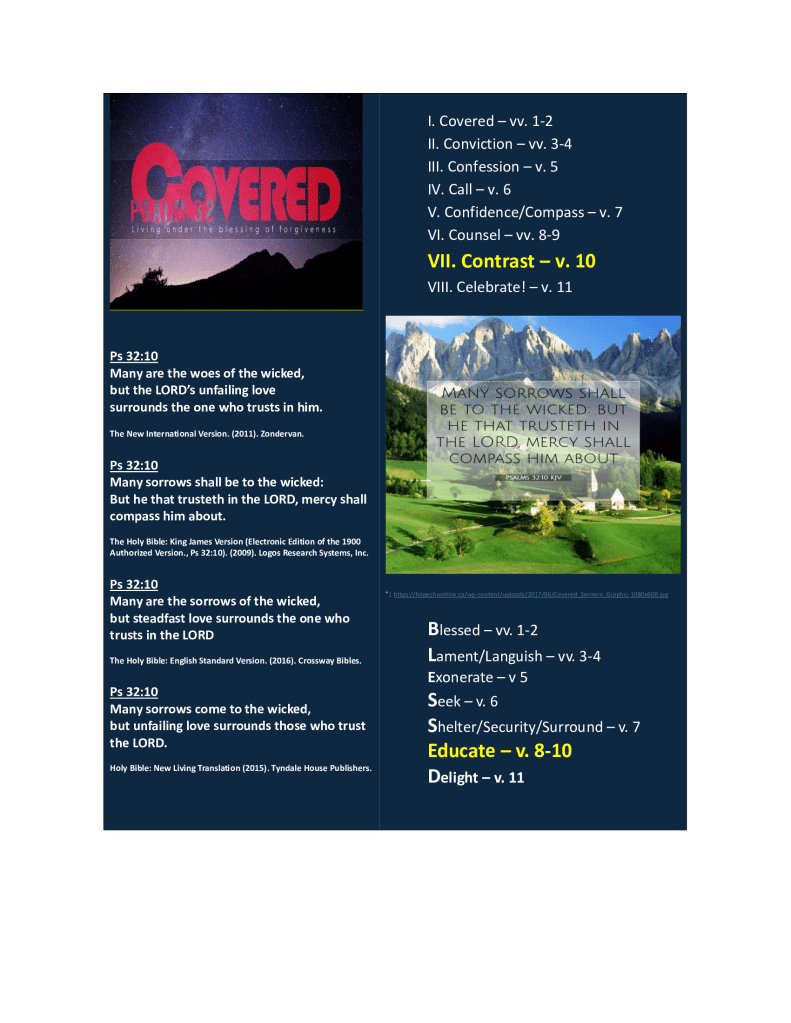
VI. Contrast, Educate, v. 10

In verse 9, David uses parabolic language to instruct the believer on how not to act.

Do not be like the horse or the mule,

which have no understanding

but must be controlled by bit and bridle

or they will not come to you.

The New International Version (Ps 32:9). (2011). Zondervan.

In verse 10, he resorts to proverbial language to drive home his point.

Many pains come to the wicked,

but the one who trusts in the LORD

will have faithful love surrounding him.

Christian Standard Bible. (2020). Holman Bible Publishers.

Here, he contrasts the life of the wicked and the believer. One must not overinterpret this passage and thus view the walk of the wicked (see QUOTES below) as always strewn with grief, sorrows, and pain (Heb. – [4799] מַכְאֹב makʾōb 16× pain, grief, sorrow, suffering [4341]).[1] Nor should God’s people expect their life to be a walk in the park. To do so would not comport with the rest of Scripture or our own experience, which certainly would lead to disappointment, disaffection, doubt, and even depression.

Grief and sorrows affect both the righteous and the wicked because of the Adamic curse. Some who fail to consider this and instead take this verse with temporal wooden literalness might use this verse to question the veracity and inspiration of Scripture and as an excuse for walking away from the faith. Others might use this verse or ones like it as a weapon to “prove” the Bible is not true. Causing some followers of Christ to stumble or feel pangs of doubt and waves of depression.

The question arises in the doubting and unbelieving that many of those the Bible identifies as wicked live at ease and seem happy. The author of Psalm 73 struggled in faith because he saw the wicked prospering and at ease.

1 Surely God is good to Israel,

         to those who are pure in heart.

 2 But as for me, my feet had almost slipped;

         I had nearly lost my foothold.

 3 For I envied the arrogant

         when I saw the prosperity of the wicked.

 4 They have no struggles;

         their bodies are healthy and strong.

 5 They are free from common human burdens;

         they are not plagued by human ills.

The New International Version (Ps 73:1–5). (2011). Zondervan.

This led to him doubting and wondering if all his trust and faithfulness were pointless.

13 Surely in vain I have kept my heart pure

         and have washed my hands in innocence.

14 All day long I have been afflicted,

         and every morning brings new punishments.

15 If I had spoken out like that,

         I would have betrayed your children.

16 When I tried to understand all this,

         it troubled me deeply

The New International Version (Ps 73:13–16). (2011). Zondervan.

But then he took the long view when reminded of what God had said of the wicked’s ultimate destiny.2

17 till I entered the sanctuary of God;

         then I understood their final destiny.

18 Surely you place them on slippery ground;

         you cast them down to ruin.

19 How suddenly are they destroyed,

         completely swept away by terrors!

20 They are like a dream when one awakes;

         when you arise, Lord,

         you will despise them as fantasies.

The New International Version (Ps 73:17–20). (2011). Zondervan.

No, verse 10 must be taken in the context of this Psalm, the Covenant God made with Israel (the blessings and curses promised (see Deut. 27:1-28.68) and from the further light as revealed in the New Testament (Covenant).

In the context3of Psalm 32, we must view it in light of the life experiences David experienced in verses 1-5 and the exhortations, instructions, declarations, and promises found in verses 6-9. In the broader context, we must view it in light of the people of the Covenant; we must see it lived out in the experience of the nation of Israel found in the Old Testament. And ultimately, we can view it in light of the future judgment of the wicked and the eternal blessings of all of God’s people. In the course of eternity, this verse will be realized completely without any exceptions.

We must also remember that this is a proverb stating a general truth. One that may not always be apparent in the lives of the wicked or those trusting in God. The wicked may prosper for a season, but when faced with pains, sorrows, and woes, they will not repent, cry out to the Lord, and experience the Lord’s comfort, love, and mercy. Instead, they will resort to suppressing their guilt, resorting to drugs or alcohol, man-centered counseling or meditation, escapism, astrology, idolatry, etc, etc, ad nauseam. Those who trust in the Lord will face times of sorrow and troubles, but when they cry out to the Lord, they will experience God’s comfort, love, and mercy even in times of trouble and testing.

Worship in Witness:

I must confess I struggle sometimes when I come to verses like this. The enemy of my soul would have me wringing my hands and questioning God’s love for me. What did I do to deserve this? Is it the weakness of my faith? Perhaps I am not His child after all.

Many a saint of God has encountered these “fiery darts of the wicked one” (Eph. 6:16)—seeds of doubt sown by the world and even well-meaning believers who ask, “Where is your faith?” followed by a slew of Scriptures taken out of context and thrown at the struggling brother or sister in Christ.

Psalm 32:10 is a promise given to those who trust in the Lord. However, the trusting saint also realizes that seasons of trials, testing, and tribulations are experienced and even promised to all believers (John 16:33).

Instead of allowing the fiery darts through to defeat us, let us don the Armor of God.

10 Finally, be strong in the Lord and in his mighty power. 11 Put on the full armor of God, so that you can take your stand against the devil’s schemes. 12 For our struggle is not against flesh and blood, but against the rulers, against the authorities, against the powers of this dark world and against the spiritual forces of evil in the heavenly realms. 13 Therefore put on the full armor of God, so that when the day of evil comes, you may be able to stand your ground, and after you have done everything, to stand. 14 Stand firm then, with the belt of truth buckled around your waist, with the breastplate of righteousness in place, 15 and with your feet fitted with the readiness that comes from the gospel of peace. 16 In addition to all this, take up the shield of faith, with which you can extinguish all the flaming arrows of the evil one. 17 Take the helmet of salvation and the sword of the Spirit, which is the word of God.

Ephesians 6:10-17

NIV 1984. International Bible Society.

Let us pray as David did in Psalm 139:23-24

23 Search me, God, and know my heart;

    test me and know my anxious thoughts.

24 See if there is any offensive way in me,

    and lead me in the way everlasting.

NIV 1984. International Bible Society.

Remember that even if God is chastising us, it’s because He loves us and does it for our good.

5 And have you completely forgotten this word of encouragement that addresses you as a father addresses his son? It says,

“My son, do not make light of the Lord’s discipline,

    and do not lose heart when he rebukes you,

6 because the Lord disciplines the one he loves,

    and he chastens everyone he accepts as his son.”

7Endure hardship as discipline; God is treating you as his children. For what children are not disciplined by their father? 8 If you are not disciplined—and everyone undergoes discipline—then you are not legitimate, not true sons and daughters at all. 9 Moreover, we have all had human fathers who disciplined us and we respected them for it. How much more should we submit to the Father of spirits and live! 10 They disciplined us for a little while as they thought best; but God disciplines us for our good, in order that we may share in his holiness.

Hebrews 12:6-10

NIV 1984. International Bible Society.

When we doubt, we will fail to sense the surrounding love of God and hear the songs of deliverance sung by those in His sheltering presence. We forget His protecting goodness and faithful guidance promised in this very Psalm.

6 Therefore let all the faithful pray to you

    while you may be found;

surely the rising of the mighty waters

    will not reach them.

7 You are my hiding place;

    you will protect me from trouble

    and surround me with songs of deliverance.

8 I will instruct you and teach you in the way you should go;

    I will counsel you with my loving eye on you.

Psalm 32:6-8

NIV 1984. International Bible Society.

Some will say that if the Lord wills, He will deliver us. But it is not so much if it is His will. It is always His will to deliver His people. Before you think that I am contradicting what I have said above, read the following thoughts. It is not a question of if He will, but when He will. It may be soon; it may be years; it may only come when we enter eternity. Those who trust in God trust in His timing.

That’s where faith, hope, and love enter the picture. Faith helps us persevere, hope keeps us patient, and love makes us endure faithfully for the one we live for.

Lord, Please Help

Lord,

Please help me to persevere,

When I am overcome by fear.

Trusting not in what I feel or see,

But to Your sheltering love, may I flee

Please help me to be patient,

Never giving up, nor complacent.

Hoping not in temporal schemes,

But in the One who eternally redeems

Please help me faithfully endure,

And from Your righteous path, never detour.

Loving not the things this world can give,

But ever for Your glory may I live.

~ Amen

Witness in Promise, Poem, Prayer, and Praise

Prepare for Battle

Don God’s armor

Prepare for battle

Make ready for war

And don’t get rattled

Our ancient foe

Seeks to unsettle

He delivers his blow

To test our mettle

Do not grow weary

And do not grow faint

Tho the battle grows dreary

And the devil seeks to attaint*

Stand firm and fight

With God’s Holy Sword

O warrior and knight

O saint of the Lord

*attaint /ə-tānt′/
transitive verb

  1. To impart a stigma to; disgrace.
  2. To pass a sentence of attainder against.
  3. To infect or corrupt, as with illness or vice.

The American Heritage® Dictionary of the English Language, 5th Edition • More at Wordnik

A Prayer When Facing Trials

Lord,

Please keep me in Your sheltering presence. 

            Then, when pestilence, persecution, or problems, 

                        both physical and intellectual, call me out to surrender. 

May I trust in You 

            as my impenetrable fortress.

                        My mighty saving hand.

And when tempted by the tempest, 

            may I keep my gaze on You 

                        and not the billowing waves. 

I pray this in the Name of the One 

            who has the words of eternal life 

                        – Jesus Christ, my Lord. Amen

Glorious Unfolding by Steven Curtis Chapman

Lay your head down tonight
Take a rest from the fight
Don’t try to figure it out
Just listen to what I’m whispering to your heart
Cause I know this is not
Anything like you thought
The story of your life was gonna be
And it feels like the end has started closing in on you
But it’s just not true
There’s so much of the story that’s still yet to unfold

And this is going to be a glorious unfolding
Just you wait and see and you will be amazed
You’ve just got to believe the story is so far from over
So hold on to every promise God has made to us
And watch this glorious unfolding

God’s plan from the start
For this world and your heart
Has been to show His glory and His grace
Forever revealing the depth and the beauty ofHis unfailing Love
And the story has only begun

And this is going to be a glorious unfolding
Just you wait and see and you will be amazed
We’ve just got to believe the story is so far from over
So hold on to every promise God has made to us
And watch this glorious unfolding

We were made to run through fields of forever
Singing songs to our Savior and King
So let us remember this life we’re living

Is just the beginning of the beginning
Of this glorious unfolding
We will watch and see and we will, be amazed
If we just keep on believing the story is so far from over
And hold on to every promise God has made to us
We’ll see the glorious unfolding

Just watch and see (unfolding)
This is just the beginning of the beginning (unfolding)

Lyrics: https://wordtoworship.com/song/13789

Video: https://youtu.be/GKMjEvF2Fkw

Caution, this video might make you cry

Footnotes:


[1] Mounce, W. D. (2006). In Mounce’s Complete Expository Dictionary of Old & New Testament Words (p. 973). Zondervan.

[2]In terms of the wicked, they may look prosperous now, but they are on slippery ground (again evoking the metaphor of the path as the journey of life) and on their way to ultimate destruction. Their life right now has as much reality as a dream, but when they awake from the dream, then they will understand that God will arise to judge them.
This is their final destiny, but what exactly is meant by this phrase is a matter of great debate. The phrase in Hebrew (lĕ’aḥărîtām) could be understood to point not to the afterlife, but to the future in this life (see the similar issue in v. 25). We must remember that there is not a clear, robust teaching on the afterlife in the Old Testament (but see Dan. 12:1–3). That said, it would seem a banal point undermined by observation and experience to believe that every wicked person who prospers would fall from their heights before their death. It seems more likely that this passage is talking about one’s ultimate fate. As time goes on and God reveals more and more about the afterlife, the psalm’s language was, and should be, read as indicating the afterlife.

Longman, T., III. (2014). Psalms: An Introduction and Commentary (D. G. Firth, Ed.; Vols. 15–16, p. 276). Inter-Varsity Press.

[3] Many sorrows shall be to the wicked] The meaning here is, probably, that those who will NOT submit themselves to God in the manner which the psalmist recommends; who ARE like the horse and the mule, needing to be restrained, and who are to be restrained only by force, will experience bitter sorrows. The psalmist may refer here, in part, to sorrows such as he says he himself experienced when he attempted to suppress the convictions of guilt (Ps 32:3-4); and partly to the punishment that will come upon the impenitent sinner for his sins. The sorrows referred to are probably both internal and external; those arising from remorse, and those which will be brought upon the guilty as a direct punishment.

[But he that trusteth in the LORD] He that has faith in God; he that so confides in him that he goes to him with the language of sincere confession.

[mercy shall compass him about] Shall surround him; shall attend him; shall be on every side of him. It shall not be only in one respect, but in all respects. He shall be “surrounded” with mercy—as one is surrounded by the air, or by the sunlight. He shall find mercy and favor everywhere, at home, abroad; by day, by night; in society, in solitude; in sickness, in health; in life, in death; in time, in eternity. He shall walk amidst mercies; he shall die amidst mercies; he shall live in a better world in the midst of eternal mercies.
(from Barnes’ Notes, Electronic Database Copyright © 1997-2014 by Biblesoft, Inc. All rights reserved.)

QUOTES:

Psalms 32:10

[Many sorrows [shall be] to the wicked] Who will not be instructed and reformed, but are like the horse and mule, without understanding; many outward sorrows or afflictions attend them; loathsome and consuming diseases come upon their bodies by intemperance and debauchery; and they and their families are brought to a piece of bread, through their vicious courses; and inward sorrows, horror and terror of mind, seize them when their consciences are at any time awakened, and are open to conviction; when a load of guilt lies on them, what remorse of conscience they feel! and what severe reflections do they make! and how are they pierced through with many sorrows! And though indeed, for the most part, wicked men have their good things in this life, and are in prosperous circumstances, and are not in trouble, as other men; yet what they have is with a curse; and they have no true peace, pleasure, and satisfaction in what they enjoy; and the curses of a righteous law; and everlasting destruction is prepared for them in the other world, when they will have many sorrows indeed; their worm will not die, and the fire of divine fury will not be quenched; there will be for ever indignation and wrath, tribulation and anguish, upon every soul of man that does evil;

[but he that trusteth in the Lord] not in his wealth and riches, in his wisdom and strength, in himself, and his own righteousness; for such are wicked persons; but in the Lord; in his righteousness to justify him, in his blood to pardon him, in his strength to support him, and in his grace to supply him with everything necessary for him;

[mercy shall compass him about] not only follow him and overtake him, but surround him; he shall be crowned with lovingkindness and tender mercies: the phrase denotes the abundance of mercies that shall be bestowed upon him here and hereafter, as both grace and glory.

(from John Gill’s Exposition of the Old and New Testaments, PC Study Bible formatted electronic database Copyright © 2011 by Biblesoft, Inc. All rights reserved.)

The reason for this caution is because the way of sin which we would persuade you to forsake will certainly end in sorrow (v. 10): Many sorrows shall be to the wicked, which will not only spoil their vain and carnal mirth, and put an end to it, but will make them pay dearly for it. Sin will have sorrow, if not repented of, everlasting sorrow. It was part of the sentence, I will greatly multiply thy sorrows. “Be wise for yourselves therefore, and turn from your wickedness, that you may prevent those sorrows, those many sorrows.”

2. Here is a word of comfort to saints, and a good reason is given for that too. (1.) They are assured that if they will but trust in the Lord, and keep closely to him, mercy shall compass them about on every side

Henry, M. (1994). Matthew Henry’s commentary on the whole Bible: complete and unabridged in one volume (p. 786). Hendrickson.