Worship in the Word and Witness
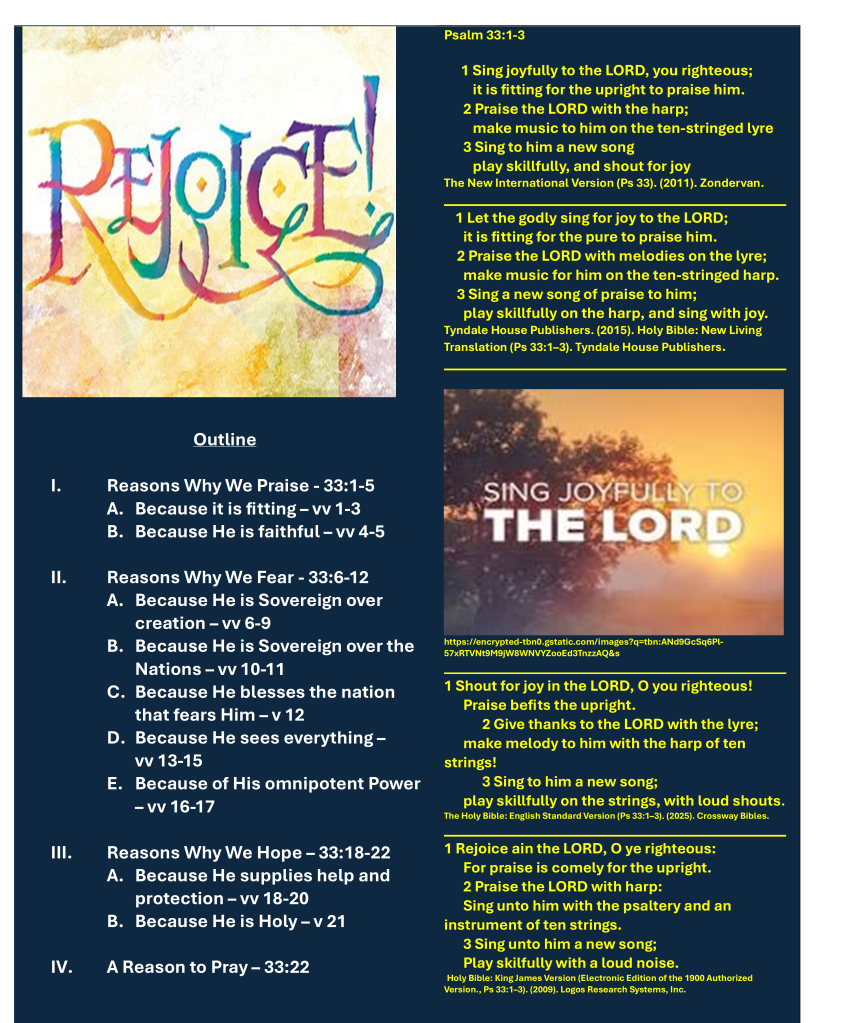
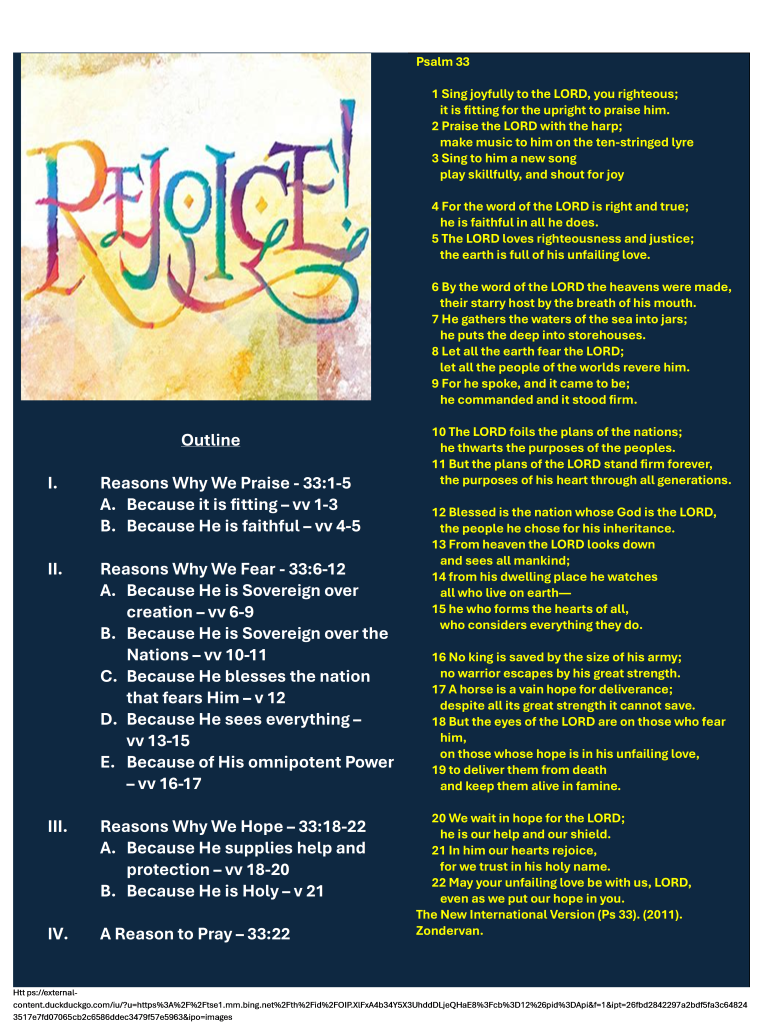
I. Reasons Why We Praise – 33:1-5
A. Because it is fitting – vv 1-3
1. With our voices – vv 1 & 3
2. With instruments skillfully – vv 2&3
3. With a new song – v 3
B. Because He is faithful – vv 4-5
I wrote last time about being sincere and mindful of how we approach worship. Specifically, that part of worship when we gather and sing to the Lord. This is the only type of praise that is “fitting.” Verse 2 continues with the exhortation that praise is not only for the voice, but we can also praise God with musical instruments. If you study church history, you will find that this has been a point of contention down the ages, with some advocating for accapella singing only and condemning instruments in worship as worldly and unscriptural for New Testament places of worship. That may sound strange to many today who have grown up in places where instruments have always accompanied the worship experience. Except for a few denominations, which reject the use of instruments in their formal time of worship, most will have at least a piano (a stringed instrument!) in their worship.
I have been in both types of services, and both are “beautiful” (v. 1 CSB). Sometimes there are no instruments available, except the human voice. I believe that arguing over instruments vs no instruments is about the same as arguing over “how many angels can dance on the head of a pin?” (which begs the question, why are they on the head of a pin in the first place? Don’t they have better things to do?😂 And then there are the anti-dancers to contend with too 🤫).
Even amongst those who use instruments, there are battles over the use of traditional instruments such as pianos, organs, and/or guitars vs. the electrically amplified and percussion instruments. The traditionalists will argue that the latter are “worldly,” forgetting or unaware that at one time or another, their instruments of choice were considered worldly as well. The amplified crowd usually argues that traditional instruments are boring and fit for a funeral. Verses taken out of context are often thrown at each other. When believers seek biblical justification for their musical preferences, they risk creating unnecessary division among God’s people—a discord orchestrated by the devil that stands in stark contrast to the harmony God desires for His church.
Brothers and sisters, whatever setting we find ourselves in, let us worship rather than judge each other. Let not taste and preference keep us from lifting our voices to the Lord. I’m sure I will get some pushback on this. Be that as it may, let us not judge by appearance and preference, but by whether it is conducive to our worship.
This is where the problem lies for many who say they can’t worship when the music is loud or too traditional. I’m sure if we were transported back to when Psalm 33 was sung or shouted, we would be uncomfortable as well and complain it’s too loud or weird. Let us be charitable with each other. I thank the Lord that I am comfortable, whether it be accapella or with instruments, traditional (which was “modern” at one time) or contemporary (which may be viewed as “old” someday). Let us not be like the world, which argues over which decade has the best music and looks with disdain on the music others like. Let each worship where they feel most comfortable, without rejecting either preference.
The “old” hymns are full of deep theological teachings that the church needs to learn, sing, and never forget. And “contemporary” songs can lift us, as it were, to the throne of God. Both styles should seek to accomplish both. Many songs in both “styles” have their share of fluffy or unorthodox lyrics. Shouldn’t depth and height be the focus when composing a song or choosing the songs we sing in our worship services? Is it understandable, biblically based, God-centered, not so much us-centered, is it being played skillfully (does it enhance our praise and display a God-given talent)? And do not reject a hymn just because someone has set it to a modern musical style. Rejoice that the rich lyrics of many old hymns are edifying a new generation. If they add a new chorus to it, don’t get angry; the hymns aren’t inspired like Scripture is, so it isn’t blasphemy to add to them as long as the addition accords with Scripture.
I did not intend to go down this road when I started. I was going to make a brief mention of the instruments we read of in verse 2 and move on. I originally intended to explore the meaning of the phrase “new song” in verse 3. That will have to wait until next time, unless another “rabbit” runs across my path that I want to chase 🏃➡️🐰😄.
Worship in Promise, Poem, Prayer, and Praise
The Song Remains the Same
Though circumstances change
And the sunny days grow dim
The Song remains the same
As we abide in Him
Things we own go up in flames
Jobs we hold may cease
The Song remains the same
He gives us abiding peace
Christ is the Song of the Ages
The true Song that never ends
The Song with infinite pages
Above all others, transcends
Come join the Song of celebration
Dance, laugh, and lift your voice
Join this happy delegation
Make a joyful noise!
God of Light and God of Glory
The overwhelming darkness
In the middle of my night
Is shattered by the presence
Of Your all surrounding light
The darkness of discouragement
Which shadows my every day
Dissolves in joyful gladness
When Your glory’s on display
The haunting tune of discord
That fills my aching soul
Becomes a beautiful melody
When Your Spirit’s in control
God of light and God of glory
Sing Your Song through me
And let me gladly disappear
So Christ is who they see
A Song of Testimony
Verse 1:
Faithful and good, righteous and just
Merciful, mighty, One we can trust
Cherished by Him who made us from dust
A refuge, a shelter from the enemy’s thrusts
Chorus:
He’s my LORD and my God
He’s my Savior and my Rock
A mighty fortress
His foes, He withstands
By loving and loyal
Omnipotent hands
Verse 2:
Provider and Guider, trusted and true
Defender, Redeemer, no other like You
Rescues from evil, the wicked should spew
To You, my Deliverer, all glory is due
Chorus:
He’s my LORD and my God
He’s my Savior and my Rock
A mighty fortress
His foes, He withstands
By loving and loyal
Omnipotent hands
All these poems and this song are from my book “The Pain and the Glory.”
If you want to order it, make sure you check the place it will be delivered. It may be set up to be delivered to me, since I have Amazon subscriptions, so I can’t remove it. Here’s the link:
https://www.amazon.com/s?k=The+Pain+and+the+Glory
*************************************************************
Notes & Quotes
Here is a remarkable fact, that the only singing in the Bible is in connection with Redemption. Even angels are never said to sing: “Praising God and saying,” not singing. “And they (redeemed men and women) sang a new song, and no man could learn that song save … they that were redeemed” (Rev. 5:9; 14:3)
Smith, J., & Lee, R. (1971). Handfuls on Purpose for Christian Workers and Bible Students, Series I–XIII (five-volume edition, Vol. 11, p. 267). William B. Eerdmans Publishing Company.
What is the sacrifice of God? Perhaps we are at the present moment offering sacrifice on the altar of God, when we praise God; for the Psalm teacheth us, in these words:* The sacrifice of praise shall glorify Me: and there is the way, where I will shew the salvation of God.
* Ps. 50:23.
Augustine of Hippo. (1847–1857). Expositions on the Book of Psalms: Psalms 1–150 (Vol. 4, pp. 388–389). F. and J. Rivington; John Henry Parker.
God’s presence begets singing and thanksgiving, while the absence of God from our congregations is the death of song, or, which amounts to the same, makes the singing lifeless, cold and formal. His conscious presence in our churches would bring back the days of praise and would restore the full chorus of song.
Bounds, E. (2003). Complete Works of E. M. Bounds. WORDsearch.
Where grace abounds, song abounds. When God is in the heart, heaven is present and melody is there, and the lips overflow out of the abundance of the heart. This is as true in the private life of the believer as it is so in the congregations of the saints. The decay of singing, the dying down and out of the spirit of praise in song, means the decline of grace in the heart and the absence of God’s presence from the people.
The main design of all singing is for God’s ear and to attract His attention and to please Him. It is “to the Lord,” for His glory, and to His honour. Certainly it is not for the glorification of the paid choir, to exalt the wonderful musical powers of the singers, nor is it to draw the people to the church, but it is for the glory of God and the good of the souls of the congregation.
Bounds, E. (2003). Complete Works of E. M. Bounds. WORDsearch.

 Psalms For The Journey