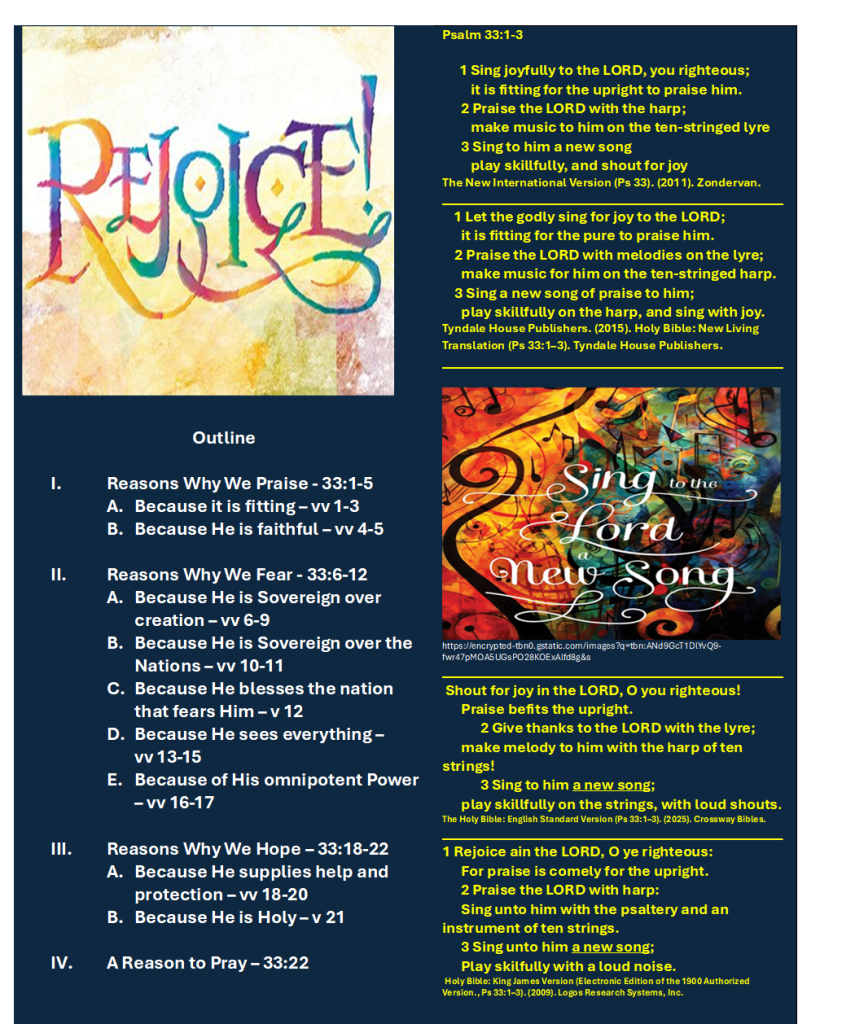
Worship in the Word
What does the Psalmist mean when he says, “Sing to Him a new song” (NASB 1995)? Was he (David?)* referring to a newly composed song or to a new, fresh attitude? Scholars have differed in their interpretations of this phrase.
Albert Barnes promotes the idea that it is a new composition:
A song specially composed for this occasion; expressive of the peculiar feelings suggested by this occasion, or appropriate to this new manifestation of the Divine goodness and mercy. Such occasions, exhibiting some new phase of the Divine goodness, demanded new language appropriate to them. So now, new hymns of praise, and new tunes in music, are demanded to meet the ever-varying manifestations of the mercy of God; and as the church is extended in the world, its modes of praise must be adapted to the new state of things which will arise.[1]
The Puritan Matthew Poole gives both views in his commentary on Psalm 33:
A new song; either, 1. Newly composed. As God gives you fresh occasions, so do not you content yourselves with the old songs or psalms, made by the holy men of God, but make new ones suited to the occasions… Or, 2. Renewed, or repeated, or sung again; in which sense Job saith his glory was new, or fresh in him, Job 29:20, i.e. renewed or continued from day to day; and the command of love is called new, John 13:34, because it was renewed and reinforced by Christ. So this song is here called new, not so much from the matter, as from the singing of it; because it was sung afresh, or again. [2]
To the first view, Poole comments:
But neither had all the righteous, to whom he speaks, ver. 1, the gift of composing songs, nor was it of any necessity or importance that they should make new songs to praise God, at least for the works here mentioned, when there were so many made by David, and other holy prophets, for the use of God’s church and people, when they had any such occasion.[3]
Another commentator makes this observation:
‘New song’ occurs elsewhere in the Psalms (40:3; 96:1; 98:1; 144:9; 149:1), as well as in Isaiah (42:10) and the book of Revelation (5:9; 14:3) in contexts connected to warfare. A new song is a hymn of victory, sung after God has made all things new by his defeat of the forces of evil. The military setting of the present psalm will become obvious in the stanzas that follow (Longman, 1984). [4]
Worship in Witness
I don’t think it is necessary to get bogged down on whether the term “New Song” means a new composition or a song sung with a new and fresh attitude. When all things are considered, both are appropriate depending on the circumstances.
Don Wyrtzen, commenting on Psalms 40 that is attributed to David, who declares “He has put a new song in my mouth,” says:
This fresh vision of God gives David exciting material for a “new song.” He may have arranged an old hymn—and discovering its genius—added fresh color and new insights. Or perhaps, in the rush of creativity and exhilaration, he composed an entirely new song. Inner joy results in music![5]
Sometimes a verse, occasion, or experience stirs one to compose a “new song.” This often happens to me when I am writing a new poem or prayer. For example, recently, I was going to share a thought after reading a portion of a study guide based on the O.T. book of Joshua for the Band of Brothers, a men’s group I am part of at the church I attend. There is a place where one can share one’s thoughts for the other members to read. As I started to write, a thought came to me: I should compose a poem instead.
However, at all times, our worship songs or prayers should be sung or said with a fresh, reverent, and sincere heart. The Nelson NKJV Study has this succinct note that sums it up aptly:
But his exhortation to sing “a new song” (v. 3) is not merely a call for new music and new hymnals. The phrase new song means to sing to God with a renewed sense of wonder at all He has done for us. The worship of God should never degenerate into something that we just do; we should always approach God with rejoicing. [6]
| If the grace of God put a new heart into our breasts, it will therewith put a new song into our mouths.7 |
7 Matthew Henry’s commentary on the whole Bible: complete and unabridged in one volume (p. 885). Hendrickson
[1] Barnes, A. (1870–1872). Notes on the Old Testament: Psalms (Vol. 1, p. 279). Blackie & Son.
2 Poole, M. (1853). Annotations upon the Holy Bible (Vol. 2, p. 50). Robert Carter and Brothers.
3 Poole, M. (1853). Annotations upon the Holy Bible (Vol. 2, p. 50). Robert Carter and Brothers.
4 Longman, T., III. (2014). Psalms: An Introduction and Commentary (D. G. Firth, Ed.; Vols. 15–16, p. 166). Inter-Varsity Press.
[5] Wyrtzen, D. (2004). A Musician Looks at the Psalms: 365 Daily Meditations (p. 124). B&H Publishing Group.
6 Radmacher, E. D., Allen, R. B., & House, H. W. (1997). The Nelson Study Bible: New King James Version (Ps 32:10–11). T. Nelson Publishers.
Worship in Promise, Poem, Prayer, and Praise
https://www.heartlight.org/gallery/4496.html
From a Holy Heart
Lord,
Let me sing to you a new song
Written from a holy heart
When I sing it with a godly throng
Let the sincere praises start
So whether new,
or tried and true
Let this be our view,
to glorify You
˜Amen
Satan’s Spoor
Oh, how the flesh seeks to deceive
And leads us to believe,
That what we are doing is good,
Instead of obeying as we should.
We rationalize our sinful decision,
And ignore God’s way of provision
To escape the flesh’s allure.
So we follow instead Satan’s spoor.
Christian, resist that fleshly thought.
Remember by whom you were bought.
Cry out for God’s help to resist,
Even as temptations persist.
And the Lord will deliver that day,
The one who will trust and obey.
(spoor: the trail left by a person or an animal)
This is the poem I referred to above in “Worship in Witness.” The lesson that day was on the flesh. Some of the verses were Romans 8:13, 1 Peter 2:11-12. I also had 1 Cor. 10:13 in mind. The prayer above is also new, based on what I wrote in the Worship in the Word and Witness sections above.
Sing a New Song written by BJ Putnam, Doug Engquist, Melody Putnam, and Riley Erin
I wanna sing a new song
Shout it out louder than before
Let the whole earth sing
The whole earth sing
Yeah, oh oh oh
There is a place
We can seek His face
Changed in His presence
Touched by His grace
There is a sound
I hear it all around
Worship is rising
And people crying out
I wanna sing a new song
Shout it out louder than before
Let the whole earth sing
The whole earth sing
It’s a song of praise
A song for all of the redeemed
Let the whole earth sing
The whole earth sing
Never the same
He’s taken my chains
There’s freedom in Jesus
Power to save
There is a name
Like no other name
There’s freedom in Jesus
Shout out His name
I wanna sing a new song
Shout it out louder than before
Let the whole earth sing
The whole earth sing
It’s a song of praise
A song for all of the redeemed
Let the whole earth sing
The whole earth sing
Hallelujah, Hallelujah, Hallelujah
Hallelujah, Hallelujah, Hallelujah
I wanna sing a new song
Shout it out louder than before
Let the whole earth sing
The whole earth sing
It’s a song of praise
A song for all of the redeemed
Let the whole earth sing
The whole earth sing
Hallelujah, Hallelujah, Hallelujah
Hallelujah, Hallelujah, Hallelujah
Hallelujah, Hallelujah, Hallelujah
Hallelujah, Hallelujah, Hallelujah
Lyrics Source – https://www.songlyrics.com/bj-putnam/sing-a-new-song-lyrics/
As sung by BJ Putnam – https://youtu.be/2ctz8m1Sc3g
As sung by Brooklyn Tabernacle Choir – https://youtu.be/MFqLddbl9Y0
***********************************************************************************************************
Notes & Quotes: For those who want further edification and are willing to take the time😊🧐🦉
*Scholars have reservations as to whether David was the author of this psalm. It is one of the few psalms without a heading. The Septuagint attributes it to David, but the Hebrew manuscripts do not. The musical references and theological themes are certainly consistent with a Davidic authorship. However, we must leave it only in the realm of possibility, though in the end, it does not really matter. The author does not lend to the power and authority of Psalm 33. The One who is being praised does.
(Otherwise known as the LXX- a Greek translation usually dated from around 250-150 BC)
It has always been a characteristic of God’s people that they are a singing people. This was Paul’s admonition when he commanded Christians in Colossians 3 and Ephesians 5 to sing. Early church father John Chrysostom emphasized the power of singing when he said, “Nothing so arouses the soul, gives it wings, sets it free from earth, releases it from the prison of the body, teaches it to love wisdom, and to condemn all the things of this life, as concordant melody and sacred song.” Ambrose of Milan, a fourth-century pastor known as the Father of Latin Hymnody said, “A psalm is the blessing of the people, the praise of God, the joy of liberty, the noise of good cheer, and the echo of gladness.” This emphasis on singing continued on through the Middle Ages and into the Reformation. Martin Luther said, “We have put this music to the living and holy Word of God in order to sing, praise, and honor it. We want the beautiful art of music to be properly used to serve her dear Creator and his Christians. He is thereby praised and honored and we are made better and stronger in faith when his holy Word is impressed on our hearts by sweet music.” Jonathan Edwards continued this emphasis when he said, “The best, most beautiful, and most perfect way that we have of expressing a sweet concord of mind to each other is by music.”
The new song of Revelation 5 praises the Lamb for his worthiness to carry out God’s redemptive plan, employing motifs from the exodus of Israel. This redemptive work includes four qualitative aspects: (1) it is for God; (2) it is accomplished through Christ’s blood; (3) it is
universal (every tribe, tongue, people, and nation); and (4) it establishes God’s kingdom or rule. The new song therefore encapsulates the theology of Revelation: the redemptive work of Christ is the sine qua non for the establishment of God’s kingdom.
Hoch, C. B., Jr. (1996). New Song. In Evangelical dictionary of biblical theology (electronic ed., p. 567). Baker Book House.
One could say that there is one new song but this song has many stanzas. All of God’s redeemed will add stanzas to that song throughout eternity as they praise him progressively and continually for his mercy, love, and grace to the children of men in both the exodus from Egypt and the cross of Calvary.
Hoch, C. B., Jr. (1996). New Song. In Evangelical dictionary of biblical theology (electronic ed., p. 567). Baker Book House.
But for the saint of today, the new song is of the release from eternal captivity, the captivity and penalty of sin. The new song is a song of salvation.
Hindson, E. E., & Kroll, W. M., eds. (1994). KJV Bible Commentary (p. 1194). Thomas Nelson.
Sing to the LORD a new song is one of the most repeated lines in the Psalter. Something has happened or is about to happen, and the only way to respond is in praise and thanksgiving. With the appearance of God in human history, music finds its place.
Waltner, J. H. (2006). Psalms (p. 479). Herald Press.
A funny thought I had when writing my last journal entry: “shout” instead of “sing” might have been more appropriate, especially for the men. After all, as you look out at the congregation, you see many tight-lipped men who refuse to sing. But those same tight-lipped men can be heard shouting at the top of their lungs at a sporting event.
 Psalms For The Journey